
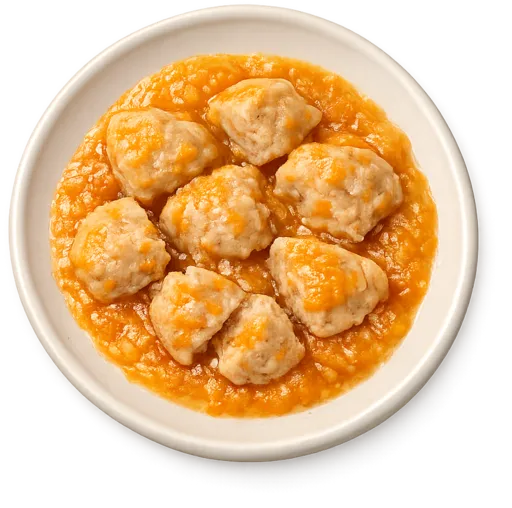
Pork Meatballs in Vegetable Sauce
From 6 months · 5 meatballs · 50 min
Ingredients
What you'll need
- Pork
- Bread
- Egg
- Garlic
- Onion
- Carrot
- Leek
- Wheat
- Olive oil
Method
🔒 The step-by-step method lives in the app
Download nappi to follow this recipe step by step — with photos, per-ingredient prep notes, and Lumi to answer questions while you cook.
How to prepare each food
Pork
Cook pork fully until no pink remains. Blend it into a smooth puree or shred it very finely, then moisten it with breast milk, formula, broth, or a vegetable puree so it isn't dry. Pork brings protein and zinc, useful nutrients at this age. Serving it alongside a vitamin-C food, like a little tomato or pepper puree, helps with iron absorption. Add no salt.
Smooth puree or fine shreds, moistened.
Tough chunks and round or tube-shaped pork (sausage, rolled cuts) are the risk. Keep pieces soft and small, and cut sausage shapes lengthwise then across so nothing round remains.
Bread
Lightly toast bread so it holds together, then cut it into finger-width strips your baby can grip. Toasting helps it firm up instead of turning gummy in the mouth. Most bread contains wheat, so introduce it on its own and watch for a reaction. Choose lower-salt bread when you can.
Finger-width strips of lightly toasted bread. Avoid soft, untoasted bread that can ball up into a gummy wad.
Soft, fresh bread can compress into a sticky wad that is hard to clear, and hard crusts can break off in firm pieces. Toast it lightly, cut it into strips or small pieces, add a thin moist spread, and always supervise eating.
Egg
Hard-cook the egg until both white and yolk are solid, then mash it smooth, or offer a well-set scramble or a soft omelet. A small amount, about a third of an egg, is plenty for a first taste.
Serve as a smooth mash, soft scramble curds, or finely chopped omelet strips.
Garlic
Garlic adds depth to early meals without any salt. Finely mince or mash a small amount and cook it soft into purees, mashed vegetables, beans, or sauces. It is a seasoning rather than a finger food, so a little stirred through a dish is all a baby needs. Skip raw garlic and whole cloves at this stage.
Finely minced or mashed and cooked soft into a dish; not a standalone piece.
Onion
Onion is usually a flavor base rather than a food on its own at this age. Cook it down until very soft and blend it into purées, mashes, or sauces. Raw onion is sharp and firm, so keep it out for now.
Finely chopped and cooked soft, blended into a purée or sauce.
Carrot
Cook carrots until very soft, so a fork slides through with no resistance. Steam, boil, or roast, then serve as a smooth purée or a soft mash. For self-feeding, offer soft-cooked finger-length batons. Raw carrot belongs only as fine shreds. Skip added salt.
Soft-cooked finger-length batons (about thumb-width) for grasping, or smooth purée/mash. Raw carrot only as fine shreds. Press-test every piece: it should squish easily between two fingers.
Raw carrot is one of the top choking hazards for young children: it is hard, firm, and breaks into round, airway-sized pieces. Always cook it until soft enough to squish between two fingers, or grate it finely. Avoid raw carrot coins, rounds, sticks, and chunks until around age 4, when chewing is reliable.
Leek
Trim and wash leeks well (grit hides between the layers), then cook them until very soft (steam, simmer, or sweat in a little oil) and finely chop or blend them into a puree, mash, or sauce. The long fibers can be stringy, so cook them down and chop small rather than serving raw or in long strips.
Cooked very soft, then finely chopped or blended into a carrier food.
Leeks have long fibers that can string together. Cook them until very soft and chop them short rather than serving them raw or in long strips.
Wheat
Wheat is one of the common food allergens, so it helps to offer it on its own first, in a small amount, and watch over the next couple of days before adding other new foods. Good early forms are a thick iron-fortified wheat cereal, soft well-cooked pasta, or lightly toasted bread cut into finger-width strips. Keep everything soft and moist, with no added salt or sugar.
Spoonable cereal, soft pasta, or finger-width strips of toast.
Soft cooked wheat foods, pasta, moist bread, couscous, are low risk when kept soft and cut small. The hazards are the hard and dry forms: whole wheat kernels (wheat berries), hard crusty bread chunks, dry seeded crackers, and popcorn, which are difficult to chew and can be inhaled. Soft bread can also clump into a sticky wad in the mouth, so offer small pieces with a drink and stay nearby.
Olive oil
Stir a small drizzle of olive oil into a smooth purée or soft mash to add calories and richness. Use it as a cooking fat for vegetables or grains, or fold a little into the finished food just before serving.
No cutting needed. Mix a small amount evenly through the food.
Putting it together
Soft pork meatballs simmered in a blended vegetable sauce.

Cook with Lumi
In the nappi app, Lumi joins you in the kitchen. Chat about any recipe: adapt it to what you have at home, swap an ingredient, or ask questions while you cook.
Chat with Lumi in the appSources14
- AAP - Starting Solid Foods (around 6 months)
- NHS - What to feed your baby from around 6 months
- USDA FoodData Central - Pork (nutrient data)
- AAP - Choking prevention guidance for infants and toddlers
- CDC - Foods that are choking hazards for infants and toddlers
- ESPGHAN 2017 - Complementary feeding position paper (gluten and allergen timing)
- AAP - Introducing common food allergens to your baby
- USDA FoodData Central - Bread (nutrient data)
- USDA FoodData Central - Egg (nutrient data)
- USDA FoodData Central - Onion (nutrient data)
- USDA FoodData Central - Carrot (nutrient data)
- USDA FoodData Central - Leek (nutrient data)
- USDA FoodData Central - Wheat (nutrient data)
- USDA FoodData Central - Olive oil (nutrient data)
General informational content, not medical advice. Always consult your pediatrician about introducing new foods, especially if your baby has any medical conditions or family history of allergies.
See this meal for your baby's age
Get prep for your baby's exact age, track what you've introduced, and plan the week. Free to try.