
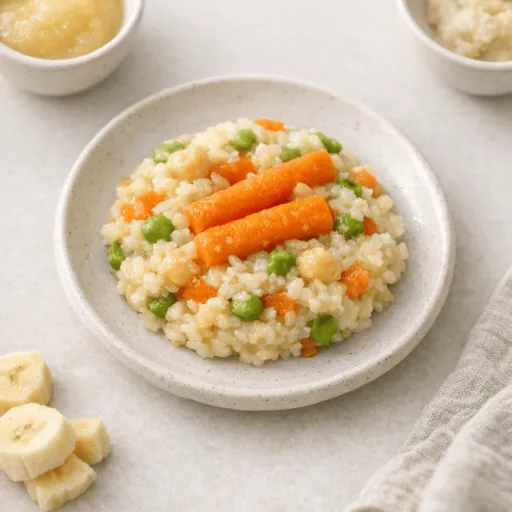
Rice, Chickpea, Peas and Carrot
From 7 months · 4 foods
Ingredients
How to prepare each food
Rice
Cook rice until soft and sticky and let it cool to warm. Serve it as a thick mash or mix it into a vegetable, meat, or fruit purée. Sticky or short-grain rice that clumps is easier for a baby to handle than loose dry grains.
Serve as a thick, sticky mash or blended into a purée. No cutting needed.
Chickpea
Cook chickpeas until fully soft, then mash or flatten them well. A smooth no-salt hummus-style mash works nicely, or stir the mash into other purées. Never offer a whole, intact chickpea at this stage.
Smooth mash, or each chickpea flattened.
A whole, intact chickpea is a choking hazard because of its round, firm shape. Mash or flatten each one until it's soft and no longer rounded. Don't offer whole chickpeas to babies and young children.
Peas
Cook peas until very soft, then burst each one or mash to a thick purée. The small round, firm shape is the part to soften, so press every pea flat before serving. Skip salt.
Burst or flatten each pea, or serve as a smooth thick mash.
Whole peas are a small round shape that can be a choking risk. Burst, smash, or halve them so no whole round pea is served, and keep watching as your baby eats.
Carrot
Cook carrots until very soft, so a fork slides through with no resistance. Steam, boil, or roast, then serve as a smooth purée or a soft mash. For self-feeding, offer soft-cooked finger-length batons. Raw carrot belongs only as fine shreds. Skip added salt.
Soft-cooked finger-length batons (about thumb-width) for grasping, or smooth purée/mash. Raw carrot only as fine shreds. Press-test every piece: it should squish easily between two fingers.
Raw carrot is one of the top choking hazards for young children: it is hard, firm, and breaks into round, airway-sized pieces. Always cook it until soft enough to squish between two fingers, or grate it finely. Avoid raw carrot coins, rounds, sticks, and chunks until around age 4, when chewing is reliable.
Putting it together
Prepare each ingredient using the age guidance above, then serve them together.
Cook with Lumi
In the nappi app, Lumi joins you in the kitchen. Chat about any recipe: adapt it to what you have at home, swap an ingredient, or ask questions while you cook.
Chat with Lumi in the appSources9
- Meal idea from NHS
- AAP - Starting Solid Foods (around 6 months)
- NHS - What to feed your baby from around 6 months
- FDA - Arsenic in rice and rice products
- AAP - Choking prevention guidance for infants and toddlers
- CDC - Foods that are choking hazards for infants and toddlers
- USDA FoodData Central - Chickpea (nutrient data)
- USDA FoodData Central - Peas (nutrient data)
- USDA FoodData Central - Carrot (nutrient data)
General informational content, not medical advice. Always consult your pediatrician about introducing new foods, especially if your baby has any medical conditions or family history of allergies.
See this meal for your baby's age
Get prep for your baby's exact age, track what you've introduced, and plan the week. Free to try.