
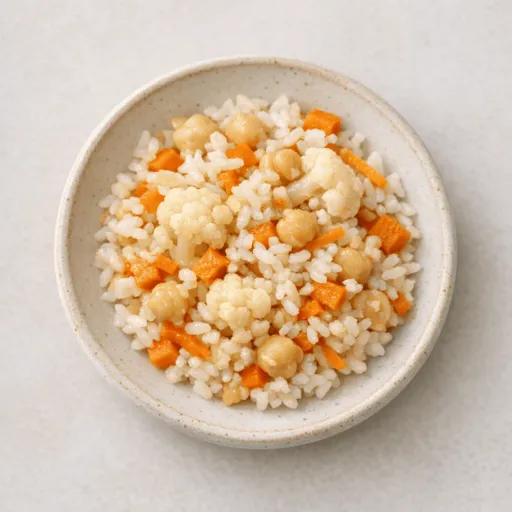
Chickpea, Rice, Carrot and Cauliflower
From 12 months · 4 foods
Ingredients
How to prepare each food
Chickpea
Offer chickpeas in soft family-style dishes, lightly squashed or chopped. Keep salt low. Round, whole legumes still warrant flattening until your child chews reliably.
Lightly squashed or chopped soft pieces.
A whole, intact chickpea is a choking hazard because of its round, firm shape. Mash or flatten each one until it's soft and no longer rounded. Don't offer whole chickpeas to babies and young children.
Rice
Serve rice as part of family meals, mixed into soft vegetables, beans, meat, or sauce. Your toddler can eat it with a spoon or hands. Keep rotating in other grains and keep salt low.
Loose soft grains, mixed into other soft foods. No cutting needed.
Carrot
Offer soft-cooked carrot or finely grated raw carrot in small pieces. Toddlers handle more texture now, but raw hard carrot stays risky without molars. Cook fork-tender or grate fine; small soft raw shreds are fine. Keep salt low.
Small soft-cooked cubes, thin cooked matchsticks, or finely grated raw carrot. Avoid raw hard coins, rounds, or thick sticks.
Raw carrot is one of the top choking hazards for young children: it is hard, firm, and breaks into round, airway-sized pieces. Always cook it until soft enough to squish between two fingers, or grate it finely. Avoid raw carrot coins, rounds, sticks, and chunks until around age 4, when chewing is reliable.
Cauliflower
Offer cauliflower close to family texture: whole soft florets and bite-size pieces are usually fine once it is cooked soft. Keep added salt low and supervise meals.
Whole soft florets or bite-size pieces.
Putting it together
Cook the chickpea with the carrot and cauliflower, then stir through the rice.

Cook with Lumi
In the nappi app, Lumi joins you in the kitchen. Chat about any recipe: adapt it to what you have at home, swap an ingredient, or ask questions while you cook.
Chat with Lumi in the appSources9
- Meal idea from NHS
- AAP - Starting Solid Foods (around 6 months)
- NHS - What to feed your baby from around 6 months
- AAP - Choking prevention guidance for infants and toddlers
- CDC - Foods that are choking hazards for infants and toddlers
- USDA FoodData Central - Chickpea (nutrient data)
- FDA - Arsenic in rice and rice products
- USDA FoodData Central - Carrot (nutrient data)
- USDA FoodData Central - Cauliflower (nutrient data)
General informational content, not medical advice. Always consult your pediatrician about introducing new foods, especially if your baby has any medical conditions or family history of allergies.
See this meal for your baby's age
Get prep for your baby's exact age, track what you've introduced, and plan the week. Free to try.