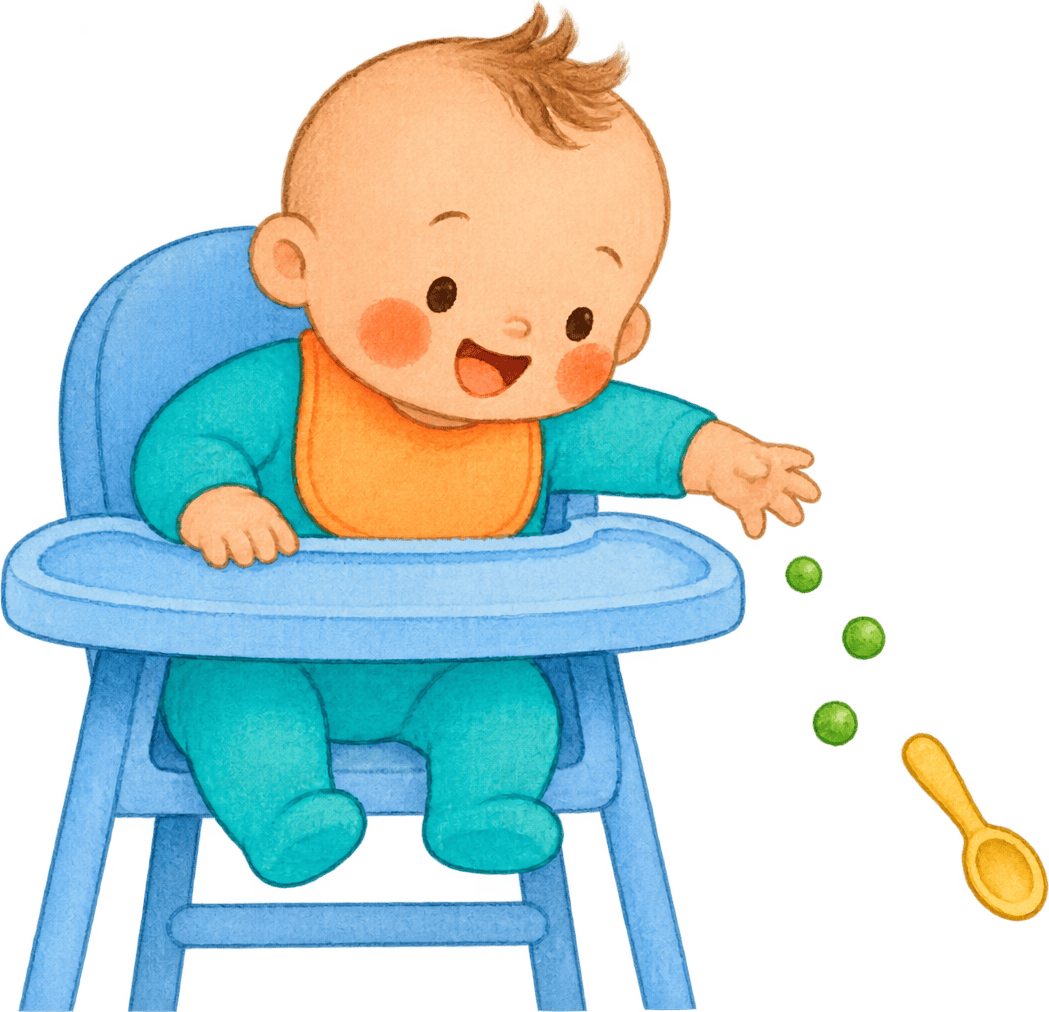
A piece of pasta goes over the edge of the high chair. Your baby leans as far as the straps allow, watches it land, then turns to look at you. A second piece follows. The dog has never been happier.
Throwing and dropping food is a normal stage, especially from about 8 months on. The American Academy of Pediatrics (AAP) describes babies between 8 and 12 months as tireless at dropping, rolling and throwing things to see what they do.1 Your baby might be testing how things fall, checking that dropped things still exist, telling you they're full, or enjoying your reaction (often several at once). Small portions, a calm and slightly boring reaction, eating together, and ending the meal once the eating has stopped all help.
Is it normal for a baby to throw food?
Yes. The AAP calls this kind of dropping and throwing a baby's way of finding out how the world works, even when it looks like random play.1
It doesn't end at the first birthday, either. Better Health Channel, the Victorian government's health site in Australia, lists squashing food, throwing it on the floor, dribbling with a full mouth and leaving food on the plate among the ordinary ways toddlers play with food.2
The mess has a purpose too. The NHS says touching and playing with food helps babies learn to eat and enjoy different foods, flavors and textures.3
If your baby was born early, count these ages from the due date. The AAP suggests using corrected age for developmental expectations during the first 2 years, so a 10-month-old born 2 months early is closer to 8 months here (corrected age).4
Why do babies drop food on purpose?
There's rarely just one reason, and a single meal can involve all of them.
They're running experiments
To a baby, food is one more object to test. Does a pea roll? Does yogurt splat? The AAP calls babies this age tiny scientists, figuring out from all that dropping which things roll and which don't.1
They're checking that things still exist
Around this age babies work out object permanence, the idea that something keeps existing after it disappears from view. The AAP says an 8-month-old will lift a scarf to find a hidden toy, and by 10 months they keep searching for it.1
The CDC's 9-month milestone checklist includes looking for objects when they're dropped out of sight, and one of its examples is a spoon.5 That lean over the side of the tray is the skill in action. Our post on 10-month milestones covers what else is going on around this age.
They're telling you they're done
Most babies can't say "I'm full" yet, so they show it. The CDC lists pushing food away, closing the mouth, turning the head away, and using hand motions or sounds among the signs that a child between 6 and 23 months may be full.6
Nemours KidsHealth makes the link to throwing directly: a toddler who is dropping carrots on the floor may be telling you they've had enough.7
They like what happens next
Throw a noodle and a grown-up gasps, laughs, says "no" or dives for the floor. That's a big payoff for one noodle. The AAP points out that all children want their parent's attention, and that toddlers may test rules to see how you react.8
What helps when a baby throws food?
Many of these ideas fit what researchers call responsive feeding. Maureen Black and Frances Aboud describe it as a loop: the adult sets up a predictable routine, the child signals, the adult answers promptly in a calm, supportive way that fits the child's age, and the child learns what to expect.9 Throwing is one of those signals.
Serve less at a time
A tray piled with food is a tray full of ammunition. Better Health suggests a few small portions, since a couple of banana slices on the floor is easier to live with than a whole banana, and you can always give more.2 KidsHealth says a couple of tablespoons is plenty to start with for a food that isn't a favorite yet.7
Keep your reaction boring
Better Health suggests saying something simple like "food is for eating" or "are you finished?", ignoring the food on the floor, and picking it up after the meal.2 The AAP notes that as long as a behavior isn't dangerous and your child gets plenty of attention for good behavior, ignoring it can be an effective way to stop it.8
Covering the floor helps with the calm part: the NHS suggests newspaper or a mat, Better Health a plastic sheet under the high chair.32
Give them a way to say "done"
Many parents teach a simple sign or phrase for "all done" and say it out loud whenever they spot a fullness cue. Some add a small bowl or a corner of the tray where unwanted food can go. Neither is guaranteed to work, but both give your baby something to do with that food besides launching it.
If your baby has eaten well and the throwing starts afterward, it's probably the "I'm full" signal. The NHS advises going at your baby's pace, stopping when they show they've had enough, and never forcing them to eat.3 At that point, calmly taking the tray away is simply answering what your baby just told you.
Eat together, without pressure
The NHS says babies copy their parents, enjoy watching you eat, and learn from being part of family mealtimes.3 KidsHealth also suggests setting your toddler a place at the family table.7
Bargaining is less helpful. KidsHealth says deals like "three more bites and you get a cookie" don't work in the long run, and that pushing food on a child who isn't hungry may dull the internal cues that tell them when they've eaten enough.7 Better Health adds that wasting a few leftovers beats battling your child over food.2
What if my baby throws most of their food and barely eats?
Look at the week, not the meal. The NHS says some days your baby will eat more, some days less, and some days they'll reject everything, and that this is normal.3
Better Health notes that toddlers are good at recognizing their own hunger and fullness signals, and suggests checking growth over a few months for reassurance.2 Our growth chart and feeding guide show what's typical by age. If you're worried your toddler consistently isn't eating enough, Better Health suggests talking with your child health nurse or doctor.2
If you log meals in nappi, the amount and a quick Liked or Refused tap let you scroll back over a whole week instead of judging by one rough dinner.
Is throwing food a safety problem?
Throwing on its own isn't. A toddler who climbs out and keeps eating on the move is another story: Better Health says eating while running around isn't safe and increases the risk of choking.2 That's one reason many parents treat getting down from the high chair as the end of the meal.
The usual food basics still apply. Our post on baby-led weaning vs purées covers both ways of starting solids, gagging vs choking explains how to tell the two apart, and the food index has preparation notes for individual foods.
Frequently Asked Questions
When do babies stop throwing food?
The guidance doesn't give a set age. The AAP ties dropping and throwing to 8 to 12 months, and Better Health still lists throwing food among normal toddler mealtime behavior, so it can stick around for a while.12 Until then, a low-key response keeps it from becoming a nightly standoff.
Does throwing food mean my baby doesn't like it?
Not necessarily. It can be an experiment, a fullness signal or a bid for your attention. The NHS says it can take 10 or more tries before a baby accepts a new food, and that funny faces don't mean they dislike it, so a food that landed on the floor is worth offering again another day.3
Is it OK to end a meal after just a few bites?
Yes, if your baby is showing you they're done. Better Health notes that the amount a toddler eats can vary from meal to meal and day to day.2 KidsHealth puts it simply: you can always offer more if your child still seems hungry, but you can't take food back once you've overfed.7
References
1. American Academy of Pediatrics. "Cognitive Development in Infants: 8 to 12 Months." HealthyChildren.org. HealthyChildren
2. Better Health Channel, Department of Health, Victoria. "Toddlers and mealtime behaviour." Better Health Channel
3. NHS. "Help your baby enjoy new foods." NHS
4. American Academy of Pediatrics. "Corrected Age for Preemies." HealthyChildren.org. HealthyChildren
5. Centers for Disease Control and Prevention. "Milestones by 9 Months." Learn the Signs. Act Early. CDC
6. Centers for Disease Control and Prevention. "Signs Your Child Is Hungry or Full." Infant and Toddler Nutrition. CDC
7. Nemours KidsHealth. "Toddlers at the Table: Avoiding Power Struggles." KidsHealth
8. American Academy of Pediatrics. "Disciplining Your Child." HealthyChildren.org. HealthyChildren
9. Black MM, Aboud FE. "Responsive feeding is embedded in a theoretical framework of responsive parenting." Journal of Nutrition. 2011;141(3):490-494. PubMed