
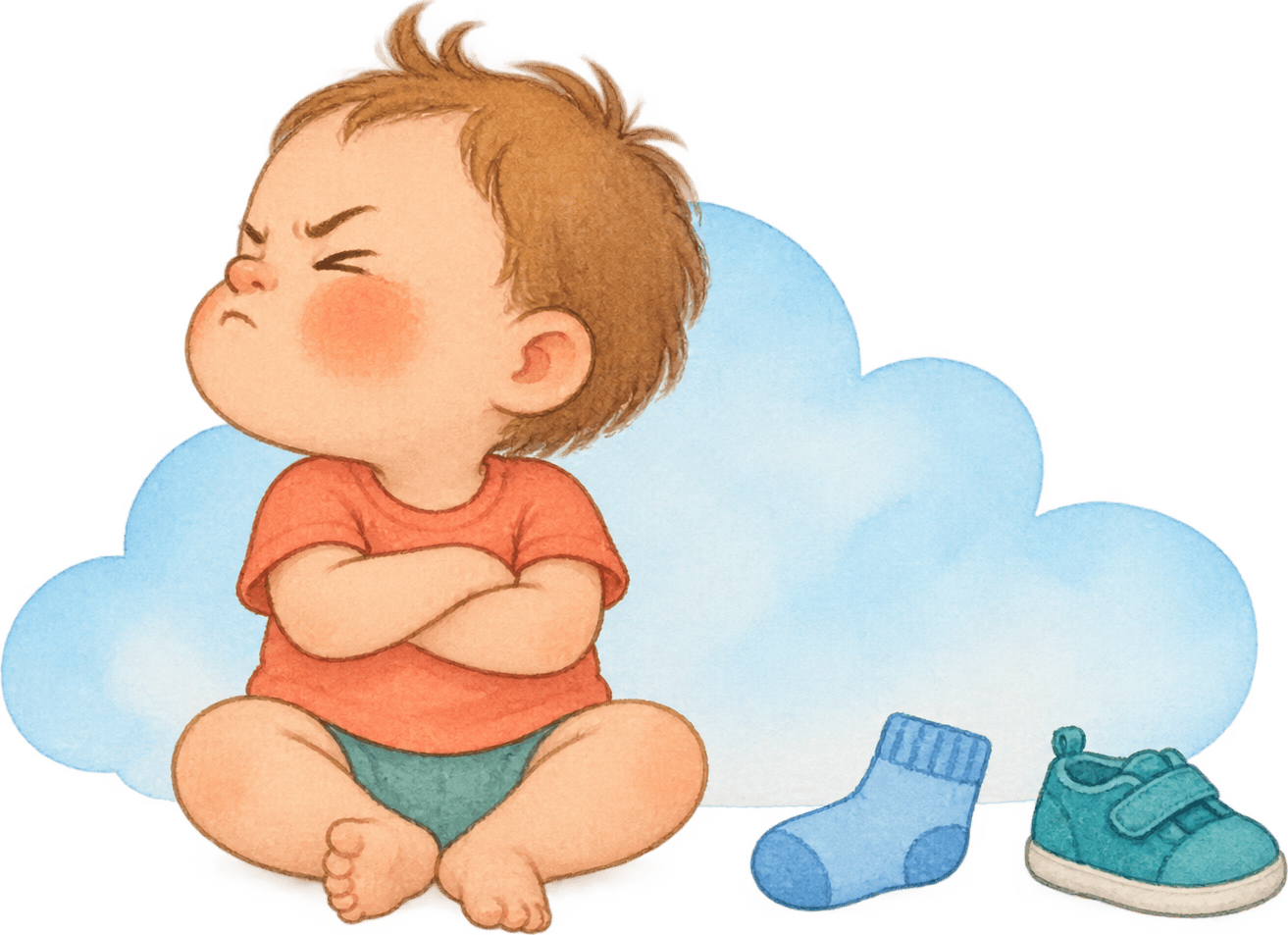
You hold up the red cup. "No." The green cup. "No!" You put both on the table, turn to the sink, and when you look back she's drinking from the green one, very pleased with herself.
That's the "no" phase, and it's a normal part of development. Somewhere in the second year, toddlers start to see themselves as separate people with their own likes and dislikes, and "no" is the quickest way to say so.1
When does the "no" phase start?
The American Academy of Pediatrics (AAP) lists a first sign at 12 months. Its social and emotional milestones for that age include "begins to show defiant behavior," especially with the adults a child feels most comfortable around.1
Next comes the word itself. By 18 months, KidsHealth says, many toddlers can indicate no and yes, with a word or a shake of the head.2
By 2 it's in full swing. The AAP describes 2-year-olds as spending most of their time testing limits: their own, yours and the world's.3
If your child was born early, count these ages from the due date (corrected age) rather than the birth date. The AAP suggests using that adjusted age to follow development until age 2.4 For the rest of what changes around the first birthday, see 12-month milestones.
Why does my toddler say no to everything?
A few things are happening at once. Most of them are good news.
She's working out that she's her own person
At 1, the AAP says, a child is "becoming their own person with their individual likes and dislikes."1 Having a preference is new. Saying it out loud is newer.
She wants more say than she can handle. KidsHealth puts it plainly: toddlers want independence and control over their environment, "more than they can actually handle," and that gap leads to power struggles.5 Most of her day is decided for her (when to eat, when to leave the park), so "no" is one of the few levers she has.
This is the flip side of the clinginess you may know from separation anxiety. The AAP describes 1-year-olds swinging back and forth between independence and clinginess, sometimes from one moment to the next.1
"No" is a word that works
It's one syllable. She can say it or shake her head.2 And it gets an instant reaction from every adult in the room, which "I'd rather wear the other shoes" can't do yet, because she doesn't have that sentence.
She's testing what happens
In the AAP's words, a toddler is "starting to recognize what's allowed and what isn't but may test some rules to see how you react."6
Every "no" is partly an experiment. Does it make the bath go away? And does it work on Grandma too?
She saves the biggest ones for you
If the babysitter swears your toddler is an angel, the AAP has an explanation: toddlers don't trust other adults enough to test their limits with them, but they'll push with you because they know you'll rescue them if needed.3
Which means the parent who hears "no" the most is often the one she trusts the most. Small comfort at 7:40 a.m. with one shoe on, but true.
What helps when your toddler says no?
You won't get rid of the word. The goal is fewer standoffs, and most of these moves work by taking the yes-or-no fight off the table before it starts.
Offer two choices you can live with
KidsHealth's tip is to give toddlers control over little things with small choices, like "Do you want orange juice or apple juice?" or "Do you want to brush your teeth before or after taking a bath?"5
Both answers have to be fine with you. "Red cup or green cup?" works. "Bath or no bath?" does not.
Say what's happening instead of asking
A yes-or-no question invites the answer you'd rather not hear. KidsHealth notes that "Do you want to brush your teeth now?" will of course be answered "no."5
Try a statement instead: "Bath time." "Shoes on, then the park." Keep the questions for the moments when "no" really is an acceptable answer.
Let the small stuff go
KidsHealth's advice is to allow control when it doesn't really matter (a mismatched outfit, say) and to choose your battles.5 Rain boots on a sunny day and dinosaur pajamas at the grocery store cost you nothing.
Hold firm on the few limits that matter
The AAP suggests setting reasonable limits that let toddlers explore, while drawing the line at anything dangerous or hurtful to others.3
For many families that's a short list: the car seat, a held hand in the parking lot, gentle hands with the dog, no hitting. A short list is easier to hold every single time. If holding the line sets off a meltdown, our post on toddler tantrums covers what helps in the moment.
Give a heads-up before a change
One of the AAP's emotional milestones for 2-year-olds is that they object to major changes in routine.3 For children who find transitions hard, the AAP suggests predictable daily routines and preparing them for a change in advance.7
Many parents use a countdown ("two more slides, then shoes") or a kitchen timer, so the timer ends playtime instead of you.
Turn the routine into a game
Plenty of parents find a game gets further than a request: a race to the bathtub, a toothbrush that "talks," pajamas hidden somewhere in the bedroom, socks that insist on going on her ears first. It's hard to refuse something that's already fun.
A bedtime that runs in the same order every night also leaves fewer steps open for debate. Our bedtime guide has typical bedtimes by age if you're setting one up.
Watch the clock, too
Timing matters. KidsHealth points out that a tired toddler is a bad match for grocery shopping or one more errand.5
If the nos pile up in the late afternoon, look at the nap. The 18-month sleep schedule covers the one-nap day, and logging naps for a week in nappi, where every caregiver sees the same timeline, makes it easier to spot whether the hardest stretches follow a short one.
Stay calm and consistent
The NHS says children need consistency, and reacting one way one day and another way the next is confusing for them. It also suggests everyone close to your child handle things the same way, and that you try to stay calm.8
Research points the same direction. A study that followed 256 mothers and children from 18 to 42 months found that more forceful control from mothers at 18 months (the researchers call it assertive control) predicted less willing cooperation at 42 months, while more defiance at 18 months predicted more forceful control later.9 The authors describe it as a two-way process: each side shapes the other.
When should you mention it to your pediatrician?
A lot of "no" from a 2-year-old is expected. The AAP suggests talking to your pediatrician if your child seems very passive or withdrawn, sad nearly all the time, or highly demanding and unsatisfied most of the time.3
Frequently asked questions
Why does my toddler say no and then do it anyway?
Often the "no" was about who gets to decide. The cup itself was fine. Toddlers want control over their world,5 so letting her make the last move (she picks the cup, she climbs in the bath herself) can settle it.
What if she says no to both choices?
Many parents keep it simple: "You pick, or I'll pick," and then calmly pick if she doesn't. The AAP's advice for toddlers is to stay consistent in enforcing limits,6 so the bath still happens either way.
Should I punish my toddler for saying no?
The AAP suggests paying attention to and praising the behavior you like, ignoring the behavior you want to discourage, and redirecting to a different activity when needed.6 A "no" on its own breaks no rule. What you act on is what happens next with the limits that matter.
References
1. American Academy of Pediatrics. "Social & Emotional Development: 1 Year Olds." HealthyChildren.org, updated 2026. Link
2. Nemours KidsHealth. "Developmental Milestones at 18 Months (1.5 Years)." Reviewed June 2025. Link
3. American Academy of Pediatrics. "Emotional Development: 2 Year Olds." HealthyChildren.org, updated 2022. Link
4. American Academy of Pediatrics. "Your Preemie's Growth & Developmental Milestones." HealthyChildren.org, updated 2024. Link
5. Nemours KidsHealth. "Temper Tantrums." Reviewed June 2022. Link
6. American Academy of Pediatrics. "What's the Best Way to Discipline My Child?" HealthyChildren.org, updated 2018. Link
7. American Academy of Pediatrics. "Understanding Your Child's Temperament: Why It's Important." HealthyChildren.org, updated 2024. Link
8. NHS. "Dealing with child behaviour problems." Page last reviewed April 2023. Link
9. Xu X, Spinrad TL, Eisenberg N, Eggum-Wilkens ND. "Longitudinal transactional relations among young children's defiance and committed compliance and maternal assertive control." Infancy. 2021;26(5):686-704. PubMed