Somewhere around the third week of freezing bags, most parents do the math for the first time. Then they do it again, because the number looks wrong. It isn't. A few bags a day for a few months turns into a whole freezer, and a goal like "six months of milk after I stop pumping" is bigger than it sounds.
A six-month stash comes down to one sum and one rule. The sum: the stored milk your baby drinks per day, times about 180 days, minus what's already in the freezer. Spread what's left over the days before you start, and that's your daily target. The rule: date every bag and use the oldest first, because the CDC puts frozen milk at best within about 6 months and acceptable up to 12.1 On a long plan, the age of the bags matters as much as the amount.
How much milk is a 6-month stash?
Start with how much stored milk your baby drinks in a day. That means milk from bottles of pumped milk only. If you'll still nurse at some feeds, don't count those.
Then multiply by the number of days you want covered. Six months is about 180 days. Subtract what you've already frozen, and you have the amount still to store.
There's no standard number to plug in here, and that's on purpose. Babies drink different amounts, and your baby's amount can change over the months. The most reliable figure is your own: log the bottles from a few typical days and take the average.
A worked example with round numbers
These numbers are made up to keep the arithmetic easy to follow. Swap in your own.
| Step | Example |
|---|---|
| Stored milk per day | 400 ml (about 13.5 oz) |
| Days to cover | 180 (about 6 months) |
| Total for 6 months | 72,000 ml (about 2,435 oz) |
| Already in the freezer | 12,000 ml (about 406 oz) |
| Still to store | 60,000 ml (about 2,030 oz) |
| Days left to build it | 120 (about 4 months) |
| Extra to store each day | 500 ml (about 17 oz) |
That's 60 liters. In 120 ml (about 4 oz) bags, it's 500 bags.
The CDC suggests freezing milk in small amounts, 2 to 4 ounces or the amount offered at one feeding, so less goes to waste.1 Small bags are also why the count climbs so fast, and why a freezer that seemed roomy in month one is full by month three.
The breast milk stash calculator does the same sum on its "Stash goal" tab. It counts real calendar days instead of rounding to 180, so its numbers will come out slightly different from a back-of-the-envelope version.
Turning the total into a daily target
Divide what's still to store by the days you have left before you'll need the stash. In the example, that's 60,000 ml over 120 days, or an extra 500 ml a day beyond any pumped milk your baby already drinks.
The daily target is a planning number. It tells you whether the plan fits your life, and what to change if it doesn't. Nobody else sets it for you. If it looks out of reach, a lactation consultant or your doctor is the right person to talk it through with.
The plan itself has two dials. You can start building earlier, which spreads the same total over more days, or you can cover fewer months with stored milk. (Recounting what's already frozen helps too. The bags at the back are easy to forget.)
Both dials change the daily number. Starting earlier also changes how old your bags will be, and that's the part people tend to miss.
How old will the bags be when your baby drinks them?
The CDC's advice is to thaw the oldest milk first: first in, first out. The quality of breast milk can decrease over time.1
Following that rule on a long plan has a predictable result. The first bag you froze is the first one your baby drinks, so on day one of the stash it's as old as your build period. The last bag you froze, right before you started, is drunk at the very end, so by then it's as old as the period you're covering.
Roughly, then, the oldest bag at the moment it's used is about as old as the longer of those two stretches (assuming you add and use milk at a steady pace).
Back to the example: a 4-month build and a 6-month cover. The first bags are about 4 months old when they're used, and the last ones are about 6 months old by the end. That stays inside the CDC's best window of about 6 months, but only just.
Now say the same parent starts 8 months early instead, to bring the daily target down to 250 ml (about 8.5 oz). The first bags would be about 8 months old when used. That's past the 6-month best window but still inside the 12-month acceptable limit.1 A longer build buys a smaller daily number and costs you fresher milk.
Bags already in the freezer before you start the plan are older still, and they go first. Check their dates.
The calculator's "Stash goal" tab flags this for you. It warns when some bags would pass 6 months by the time they're used, and again if any would pass the 12-month limit.
Label every bag with the date
The CDC says to clearly label breast milk with the date it was expressed.1 On a six-month plan, that date is the only thing that tells you which bag goes next.
A few habits make oldest-first easier when the freezer holds hundreds of bags:
- Freeze bags flat, then file them upright so every date is readable.
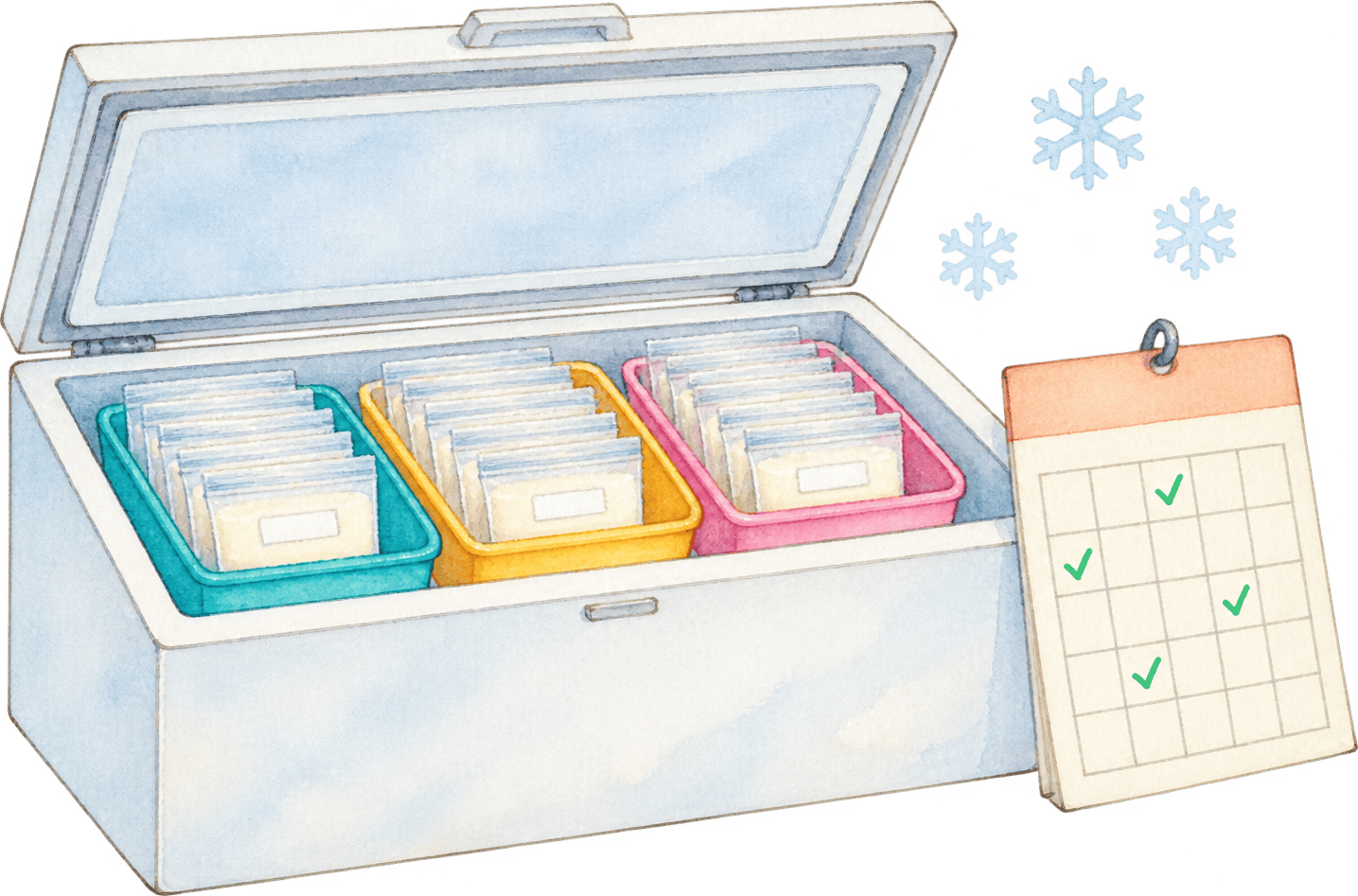
- Group bags by the month they were pumped, in separate bins or boxes.
- Add new bags at the back and take from the front.
- Keep the stash away from the freezer door. The CDC recommends storing milk further inside, where it's protected from temperature changes when the door opens.1
Month bins help with planning too. One glance shows how much of the stash is from four months ago and how much is from last week.
Using the stash: thawing and the 24-hour clock
Once a bag thaws in the fridge, the CDC says to use it within 24 hours. That clock starts when the milk is completely thawed, not when it came out of the freezer.1
Thawed milk is never refrozen.1 Milk that's been brought to room temperature or warmed is used within 2 hours.1
That's another reason small bags pay off on a long plan. You thaw what one feed needs and nothing sits in the fridge counting down.
Frequently Asked Questions
How long does frozen breast milk last?
According to the CDC, about 6 months is best and up to 12 months is acceptable. Fresh milk keeps up to 4 days in the fridge, and the CDC says to freeze it right away if you don't think you'll use it in that time.1
Is it okay to use a bag that's older than 6 months?
The CDC calls up to 12 months acceptable, with about 6 months as best.1 Using the oldest bags first keeps as much of the stash as possible inside the 6-month window.
Can I refreeze breast milk after it thaws?
No. The CDC says never to refreeze thawed breast milk. Use milk thawed in the fridge within 24 hours of fully thawing.1
What if my baby's daily amount changes?
Redo the sum. The plan assumes your baby drinks the same amount of stored milk every day, and that amount can change over the months. Rechecking it every few weeks keeps the total and the daily target up to date.
If you're planning a long stash, try the numbers in the breast milk stash calculator first, then revisit them once a month as your baby's daily amount settles. The feeding guide covers how feeding changes by age, and our post on tracking a breast milk stash compares ways to keep the bags organized. In nappi, logging bags and seeing each one's use-by date is free. For every storage time, including room temperature and leftovers, see our breast milk storage guidelines. If you'll keep pumping at work, how much breast milk to store before going back to work covers the smaller buffer stash.
References
1. Centers for Disease Control and Prevention. "Breast Milk Storage and Preparation." Link