
Grandma flew in for the holidays. She walks through the door with her arms already out, and the baby who used to grin at the mail carrier takes one look, buries her face in your shoulder and howls. Grandma laughs it off. You can tell it stings.
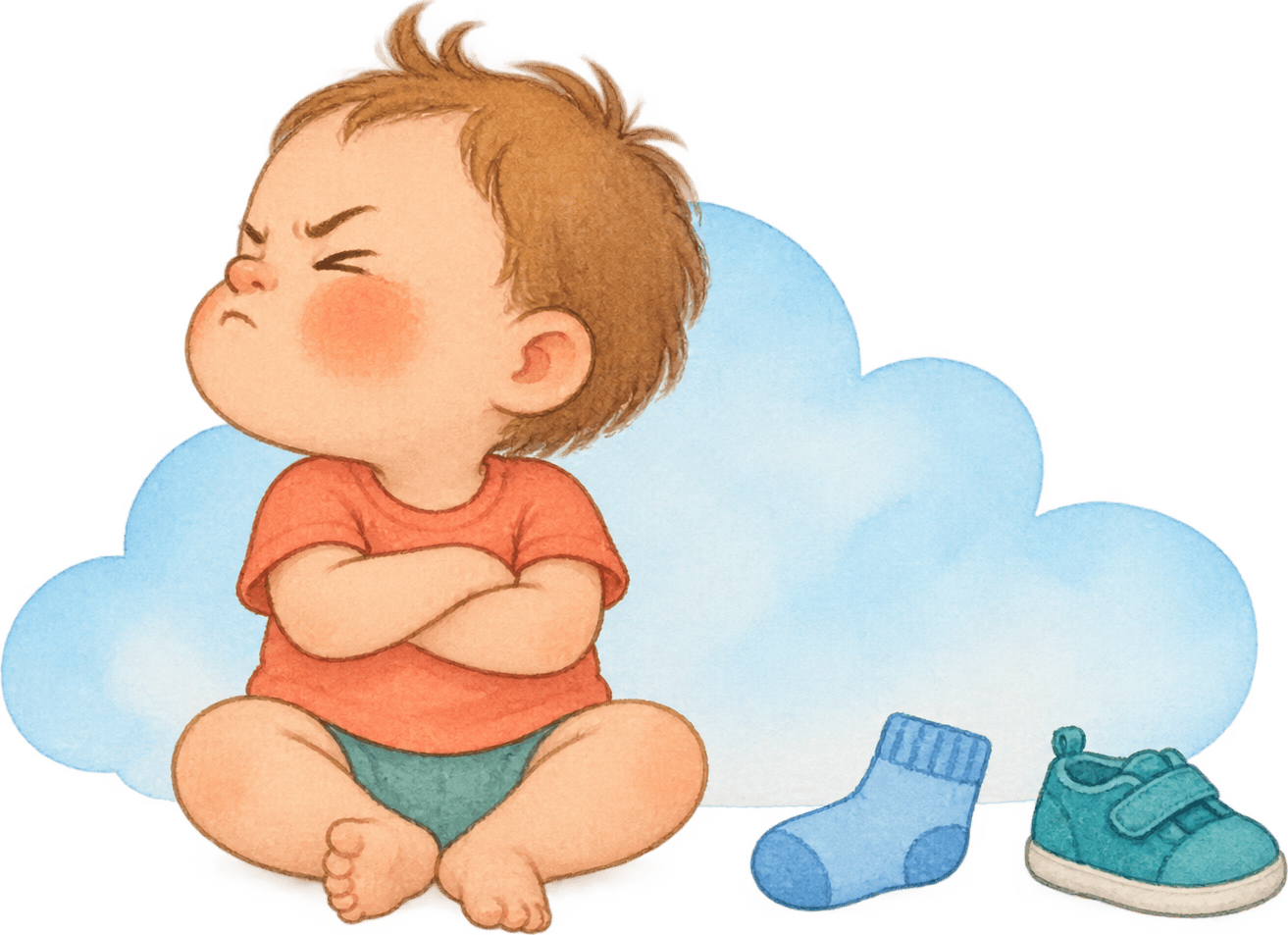
That's stranger anxiety, a normal stage of development in which babies get wary of people they don't know well or don't see often. They may cling, hide or cry when one of those people comes close. It can first show up between 4 and 7 months and is common at around 9 months.12 It means your baby can now tell familiar faces from unfamiliar ones, and that she's strongly attached to you.
When does stranger anxiety start and when does it end?
The first wariness can appear between 4 and 7 months. The American Academy of Pediatrics (AAP) explains that as babies learn to tell family members apart from strangers, they may start to show stranger anxiety.1
By 9 months it's on the AAP's list of social milestones: babies this age often become "shy, clingy, or fearful around strangers."2 The NHS describes fear of strangers as common in young children anywhere between 6 months and 3 years.3
There's no set end date. A study that followed 1,285 twins from 6 to 36 months found that wariness of strangers rose, on average, between 6 and 12 months, then children went different ways. In the typical pattern it leveled off in the second year, while a smaller group started out very wary and grew less so.4
The AAP's view is that meeting strangers gets easier, bit by bit, as your child's sense of self grows more secure.2
Born early? Count these ages from the due date (corrected age), which the AAP recommends for judging development in the first 2 years. A 9-month-old born 2 months early has a corrected age of 7 months, so compare her with 7-month-olds.5
Why does my baby cry when someone else holds them?
Your baby has gotten much better at sorting faces. The AAP describes babies this age as getting better "at telling the difference between familiar people and unfamiliar people and situations."2 Once she can spot who's new, new people feel less safe.
Attachment is the other half. According to the AAP, a baby's growing attachment to her parents can lead to both stranger anxiety and separation anxiety.2 You're her safe base, and everyone else gets measured against you.
And no, you didn't cause it by holding her too much. If someone says your baby is fearful because she's spoiled, the AAP's answer is "don't believe it."2
Even familiar people can get the treatment. Relatives and babysitters she used to be comfortable with can set off hiding or crying, especially if they approach quickly.2 Temperament plays a part too: some babies are outgoing, while others need more time with new people.1
Why does my baby look at me before deciding about a new person?
Next time someone walks in, watch her look at the newcomer, then at your face, then back. Researchers call this social referencing: using another person's reading of a situation to decide how to feel about it.6
The skill builds at the end of the first year and through the second. In a study of babies aged 6 to 22 months, the older ones were more likely to look straight at a parent's face.7
What you say to her matters. In a study of 87 ten-month-olds, babies were friendlier to a stranger when their mothers had talked to them about that person in a positive tone rather than a neutral one. At that age, only the message aimed at the baby worked, not watching the mother chat with the stranger.6
A little later, what babies watch counts too. When 12- to 14-month-olds saw their mothers act nervous and hesitant with a stranger, they were more fearful and avoidant of that person than after a relaxed conversation.8
In practice, the way you greet a visitor tells your baby something. A relaxed hello to them and a cheerful word to her about them say this person is okay.
How can grandparents and visitors help a baby warm up?
The AAP's main advice is to give your baby time to warm up instead of pushing her to interact before she's ready.2 For babies who need more time, it adds that other people should approach slowly while the baby watches from the sidelines.1
| Situation | What tends to help |
|---|---|
| Grandparents arrive | They chat with you first while she watches from your lap |
| A new babysitter | A visit ahead of time, with you in the room |
| A holiday gathering | One new person at a time, and a quiet room to step away to |
| A relative she mostly sees on video calls | She may still treat them as new in person |
Keep her close while she watches
Your lap, or the floor right next to you, gives her a safe spot to study the newcomer. The AAP's advice for a baby's new fears in general fits here: be close by so she can turn to you, and stay calm so she can see you're not afraid.2
Let the visitor go slow and play nearby first
Ask the visitor to skip the arms-out greeting. Talking with you, sitting at her level and offering a toy from a little distance give her room to decide. Holding can wait. Many parents find their baby makes the first move once nobody is pushing.
Be visibly friendly with the newcomer
Smile, chat, hug if that's your family's style. Then turn to your baby and say, in a happy voice, something like "That's Abuela! She brought you a book." Given what the social referencing studies found, your easy tone is doing real work.68
Pick a moment when she's rested and fed
Plenty of families plan first meetings for after a nap and a feed, not the end of a long afternoon. Busy holiday days push naps around, so keep an eye on her wake windows. If grandparents or a sitter share the care, a shared timeline in nappi shows them when she last slept and ate.
Meet a new sitter before you need one
KidsHealth suggests introducing new people slowly and inviting a new babysitter or relative over in advance, so they can spend time with your baby while you're in the room.9 Our separation anxiety guide covers the goodbye itself, and the first weeks of daycare covers group care.
Don't pass her around
At a big gathering, a baby can end up in six sets of arms in ten minutes. That's a lot for anyone, let alone a tired baby. It's fine to hold her yourself and let relatives come to you.
What should I tell relatives who feel rejected?
Tell them it isn't personal, because it isn't. Their grandchild is crying because she can now tell her everyday people from everyone else, which is exactly what the AAP describes at this age.2 If it's a parent who keeps getting turned away, see when your toddler only wants one parent.
A short line helps: "She does this with everyone right now. Sit with us for a bit and let her come to you."
Then give them a job that doesn't involve holding: a board book next to her, a ball rolled across the rug, peekaboo from the couch. For what else is typical around now, see our 9-month milestones guide.
Frequently asked questions
Is stranger anxiety the same as separation anxiety?
They're related but different. Stranger anxiety is about who's there: unfamiliar people coming close. Separation anxiety is about you leaving, even when someone familiar stays with her. The AAP links both to the same growing attachment.2 Our separation anxiety guide covers the goodbye side.
My 7-month-old is happy with everyone. Is that okay?
Babies vary a lot here. Some are outgoing, and others take more time with new people.1 If anything about your baby's social or emotional development worries you, the AAP encourages you to tell your pediatrician what you notice day to day.1
Will my baby cry at every visit from now on?
Probably not. The AAP notes that once a baby feels secure, she gradually becomes more responsive to the people around her.1 A grandparent who comes back often and lets her set the pace gives her that chance.
Next time someone new comes over, try the slow version once: your baby on your lap, a warm hello from you, the visitor on the floor with a toy. Then let her decide when she's ready.
References
1. American Academy of Pediatrics. "Emotional and Social Development: 4 to 7 Months Old." HealthyChildren.org. healthychildren.org
2. American Academy of Pediatrics. "Social and Emotional Development: 9 Months Old." HealthyChildren.org. healthychildren.org
3. NHS. "Separation anxiety." NHS.uk. nhs.uk
4. Brooker RJ, Buss KA, Lemery-Chalfant K, Aksan N, Davidson RJ, Goldsmith HH. "The development of stranger fear in infancy and toddlerhood: normative development, individual differences, antecedents, and outcomes." Developmental Science. 2013;16(6):864-878. PubMed
5. American Academy of Pediatrics. "Corrected Age For Preemies." HealthyChildren.org. healthychildren.org
6. Feinman S, Lewis M. "Social referencing at ten months: a second-order effect on infants' responses to strangers." Child Development. 1983;54(4):878-887. PubMed
7. Walden TA, Ogan TA. "The development of social referencing." Child Development. 1988;59(5):1230-1240. PubMed
8. de Rosnay M, Cooper PJ, Tsigaras N, Murray L. "Transmission of social anxiety from mother to infant: an experimental study using a social referencing paradigm." Behaviour Research and Therapy. 2006;44(8):1165-1175. PubMed
9. Nemours KidsHealth. "Separation Anxiety." kidshealth.org