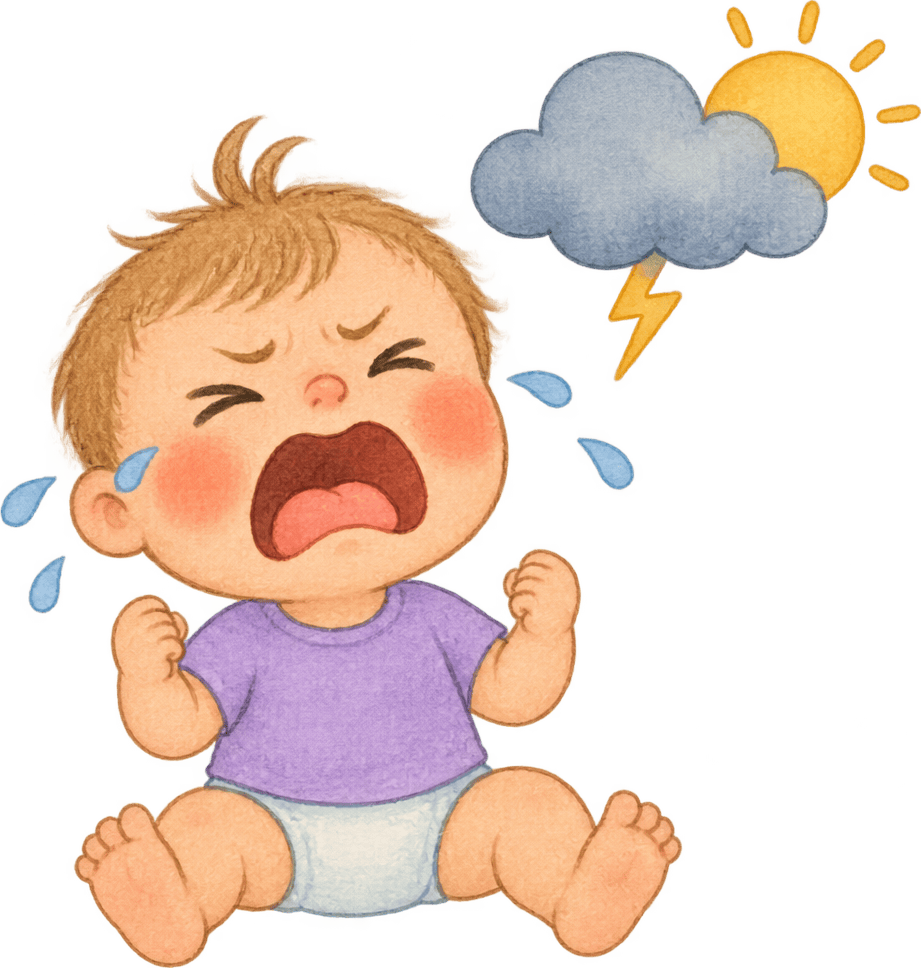
The blue cup is in the dishwasher. You offered the green one, which is the same cup in green. Your 20-month-old is now flat on the kitchen floor, back arched, kicking, crying as if the green cup had betrayed her personally.
That's a tantrum, and it's one of the most ordinary things a toddler does. Tantrums usually start between 12 and 18 months, are most common between ages 1 and 3, and most are over within five minutes.1234 They happen because toddlers have big feelings before they have the words or the self-control to handle them.
When do toddler tantrums start?
Around 18 months is typical, according to the NHS, the UK's National Health Service.1 MedlinePlus, the US National Library of Medicine's health site, gives a wider window: anywhere from 12 months to age 3.2 Boys and girls have them about equally, and KidsHealth counts both frequent and rare tantrums as normal.3
For a child born early, these ages count from the due date until age 2. That's corrected age, which the AAP says gives a better idea of when to expect developmental milestones.5 A 20-month-old born 2 months early has a corrected age of 18 months.
Why do toddlers have tantrums?
Mostly because of a gap between what they feel and what they can do about it. Language is a big part of that gap. Toddlers want to tell you things and can't yet, and the NHS describes that frustration coming out as a tantrum.1 Words for feelings are harder still: KidsHealth notes they develop later than other words.3
In a study where 2,001 mothers reported on toddlers aged 12 to 38 months, children who spoke fewer words had more severe tantrums: more frequent, and less under control. Late talkers at 24 to 30 months were about twice as likely to have severe tantrums as other toddlers.6 Our 12-month milestones post covers what early talking usually looks like.
Self-control lags behind, too. The AAP describes 2-year-olds as still struggling to control their impulses and feelings, so anger erupts suddenly as crying, hitting or screaming.7 Then there's independence. KidsHealth describes toddlers as wanting more control over their world than they can handle yet.3 That same push is behind the "no" phase.
None of this means you're doing it wrong. MedlinePlus says it plainly: tantrums are normal, they aren't your fault, and they don't make your child a bad child.2
How long do toddler tantrums last?
Less time than it feels like. In a study of parents' accounts of tantrums in 335 children aged 18 months to 5 years, the most common length was 30 seconds to 1 minute, and 75% lasted 5 minutes or less.4
The same researchers found that anger peaks near the start and then fades, while crying and comfort-seeking slowly build toward the end.4 The kicking comes first. The part where your child wants to be held comes later, and that's your opening.
How often do toddlers have tantrums?
At this age, tantrums can be a daily thing: MedlinePlus says children from 12 months to age 3 can have them at least once a day.2
They thin out with age. In a study of nearly 1,500 children aged 3 to 5, 83.7% had tantrums at least sometimes, but only 8.6% had them every day.8 The NHS says tantrums are far less common by age 4, as children talk more.1
What triggers a toddler tantrum?
The NHS, KidsHealth and MedlinePlus name mostly the same triggers.123
| Trigger | An everyday example |
|---|---|
| Tiredness | The 5 p.m. meltdown after a short nap |
| Hunger | Demanding a snack in the checkout line |
| Feeling sick or uncomfortable | A very short fuse during a cold |
| Hearing no | The cookie, the tablet, your phone |
| Not being able to do something | The shoe that won't go on |
| Wanting your attention right now | You're on the phone |
| Jealousy | Another child has the truck |
Changes to the routine count too: the AAP lists objecting to them as a normal milestone at 2, and notes that a 2-year-old may throw a tantrum just before being left with a sitter.7 If drop-offs are the hard part, see our post on separation anxiety.
Sleep is the trigger with the most room to work on. KidsHealth says getting enough sleep can greatly reduce tantrums.3 Our sleep needs by age guide has typical totals, and the 18-month sleep schedule shows how one nap fits into the day.
What helps during a tantrum?
Catching it early is the easiest win. When you see one coming, the NHS suggests distracting your child right away ("Look! A cat!").1
Once it's under way, safety comes first. KidsHealth suggests moving a child who might hurt themselves or someone else to a quiet, safe place, and MedlinePlus mentions the car or a restroom when you're out.23 If your child hits or bites, the NHS advises never hitting back and making it clear that it hurts and you won't allow it.1
Then stay calm, or at least look calm. Shouting back won't end a tantrum, the NHS says.1 Naming the feeling helps, too. Something like "I know you're feeling angry about…" shows you see the frustration and gives your child words for it.1
The thing to hold firm on is the demand itself. If you've said no, the NHS advises against switching to yes to end the tantrum, because your child learns that tantrums work.1
As long as your child is safe, the AAP says ignoring the behavior can be an effective way to stop it, and MedlinePlus notes that a tantrum without an audience may end sooner.29 With a young toddler, many parents stay close, quiet and unbothered: the tantrum loses its audience, but your child doesn't lose you.
When the storm passes, KidsHealth suggests praising your child for calming down, then a hug and reassurance that they're loved no matter what.3
Does spanking or yelling stop tantrums?
No, according to the AAP. It says spanking, slapping, yelling and shaming don't work well to change behavior and can harm a child's long-term physical and mental health, and that spanking often increases aggression and anger.9
On the hard days, the AAP suggests giving yourself a time-out: make sure your child is somewhere safe, breathe for a few minutes, then start over.9 MedlinePlus suggests asking your health care provider for help if you can't control your own anger, or you worry you might react physically.2
How can you prevent some tantrums?
You won't prevent all of them, but these habits cut down on the avoidable ones:
- Keep naps and meals steady. The AAP suggests heading off tiredness and hunger with well-timed naps and meals.9
- Offer small choices: orange juice or apple juice, teeth before the bath or after. KidsHealth suggests giving toddlers control over little things, and MedlinePlus adds that a choice should be a real one.23
- Give a heads-up before a change, as the AAP suggests.9 "Two more slides, then we go home" counts.
- Put off-limits things out of sight, so there's less to say no to.3
- Save the firm no for safety, like the hot stove or the car seat buckle, rather than battling over which shoes, as MedlinePlus puts it.2
- Notice the calm moments. The AAP and KidsHealth both suggest "catching them being good" with specific praise.39
If meltdowns cluster at certain times, a week of logged naps and meals can show whether they line up with a short nap or a late lunch. In nappi, everyone who cares for your child logs to the same timeline, so the sitter's short nap doesn't stay a mystery.
When should you talk to your pediatrician about tantrums?
Most tantrums aren't a cause for concern and stop on their own, KidsHealth notes.3 MedlinePlus lists when the AAP recommends contacting your child's provider, including:2
- tantrums that get worse or happen often after age 5
- injuring themselves or others, or destroying property, during tantrums
- holding their breath during tantrums, especially if they faint
- other changes at the same time, such as nightmares, losing toilet training, stomachaches, refusing to eat or go to bed, or clinging
KidsHealth adds tantrums that are becoming more frequent, more intense or longer, and notes that hearing problems or language delays can make tantrums more likely.3 Researchers describe the concerning kind as unpredictable, prolonged or destructive.8
Frequently asked questions
Why are tantrums worse with me than with the sitter?
The AAP says it's common for toddlers to behave better with sitters or relatives. They don't trust other adults enough to test their limits, but they test yours, because they know you'll rescue them if needed.7
Is it OK to change my mind after saying no?
Before a tantrum, yes: KidsHealth says it's fine to reconsider a request and choose your battles.3 Once a tantrum has started, the NHS advises against giving in, because your child learns that tantrums get results.1
References
1. NHS. "Temper tantrums." NHS
2. MedlinePlus, US National Library of Medicine. "Temper tantrums." MedlinePlus
3. Nemours KidsHealth. "Temper Tantrums." Reviewed by Elizabeth M. Schilling, PhD. KidsHealth
4. Potegal M, Kosorok MR, Davidson RJ. "Temper tantrums in young children: 2. Tantrum duration and temporal organization." J Dev Behav Pediatr. 2003;24(3):148-154. PubMed
5. American Academy of Pediatrics, HealthyChildren.org. "Corrected Age For Preemies." HealthyChildren.org
6. Manning BL, Roberts MY, Estabrook R, et al. "Relations Between Toddler Expressive Language and Temper Tantrums in a Community Sample." J Appl Dev Psychol. 2019;65:101070. PubMed
7. American Academy of Pediatrics, HealthyChildren.org. "Emotional Development: 2 Year Olds." HealthyChildren.org
8. Wakschlag LS, Choi SW, Carter AS, et al. "Defining the developmental parameters of temper loss in early childhood: implications for developmental psychopathology." J Child Psychol Psychiatry. 2012;53(11):1099-1108. PubMed
9. American Academy of Pediatrics, HealthyChildren.org. "What's the Best Way to Discipline My Child?" HealthyChildren.org