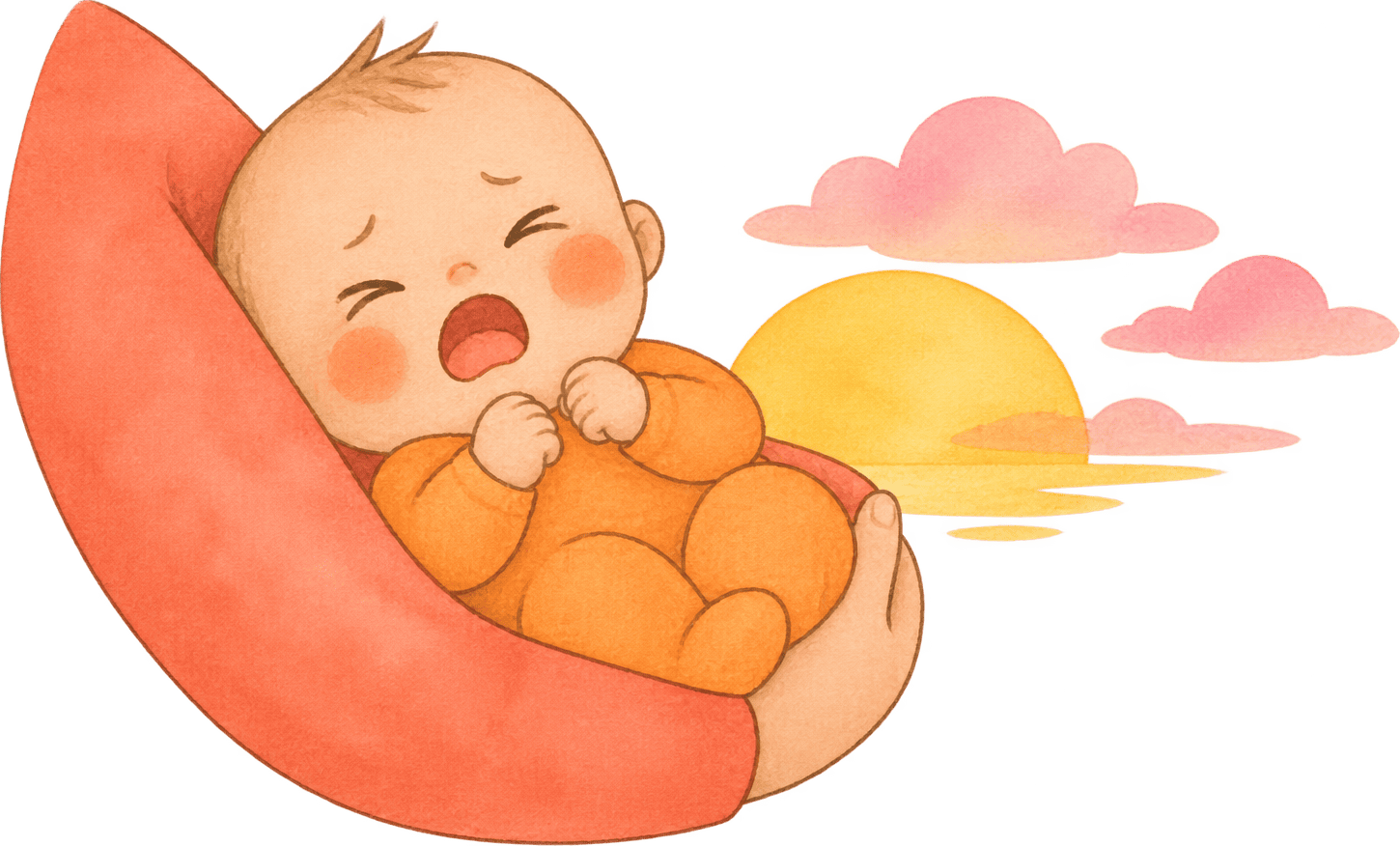
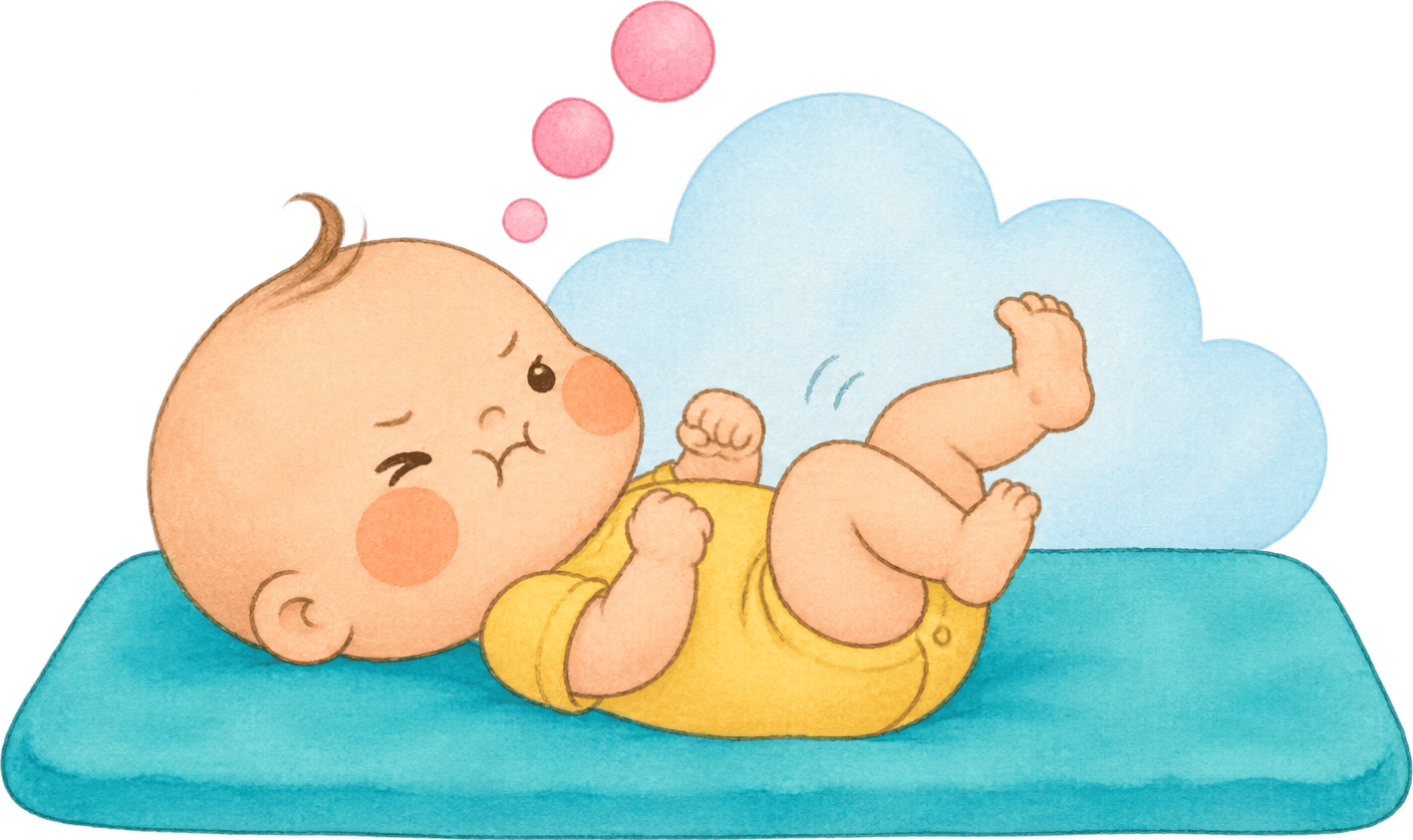
She finished the bottle twenty minutes ago and has been working on something ever since. Knees up, fists tight, face going from pink to red to a purple you didn't know a person could turn, grunting like she's moving furniture. Then a small, completely soft poo arrives, and she looks around as if nothing happened.
Most newborn gas and grunting is normal. Young babies swallow air when they feed and when they cry, and their gut makes gas as it breaks down milk.1 Many also grunt and strain before a soft poo.2 When the straining runs long, doctors call it infant dyschezia: the baby hasn't yet learned to relax the pelvic floor while pushing, and it usually clears up on its own.3
Why do newborns get so much gas?
Air goes in with every feed. Some babies gulp fast, and young babies don't always close their lips tightly around the breast or bottle.1 The American Academy of Pediatrics (AAP) says swallowed air happens with both, but it's seen more often with the bottle.4
Crying lets in more. Australia's Pregnancy, Birth and Baby service lists crying right alongside feeding as a time babies swallow air, and notes that some gas is made inside the baby as milk breaks down in the gut.1
The rest is practice. The AAP describes newborns as still getting used to the feeling of gas and learning to let it pass. It calls the discomfort real but not dangerous, and says gas pain typically peaks at 6 to 8 weeks and improves a lot by 3 months.5
If your baby was born early, read these ages as corrected age, counted from the due date, which is how the AAP suggests judging what's typical for a preterm baby in the first two years.6
Why does my baby grunt and turn red before pooing?
Grunting while pushing out a poo is on the AAP's list of normal newborn noises.2
When the straining goes on for a while and comes with crying, it has a name. The Rome IV criteria, the international definitions doctors use for functional gut problems in babies, describe infant dyschezia as at least 10 minutes of straining and crying before passing soft stools (or trying and not passing any) in a baby under 9 months with no other health problems. The authors add that an episode usually lasts 10 to 20 minutes and that these babies still poo several times a day.3
The trouble is coordination. A poo takes two things at once: pushing with the belly and relaxing the pelvic floor muscles. A young baby hasn't linked the two yet, so they push hard against muscles that are still clenched.3
It's most common early and fades fast. In a Dutch population study cited in Rome IV, 3.9% of babies had dyschezia at 1 month and 0.9% at 3 months, and in most babies it clears on its own after 3 to 4 weeks.3
Gas, dyschezia and constipation can look alike from the outside. Side by side:
| How the sources describe it | |
|---|---|
| Gas | Swallowed air plus gas from digesting milk; burps, farts and squirming. Discomfort typically peaks at 6 to 8 weeks.15 |
| Infant dyschezia | At least 10 minutes of straining and crying, then a soft poo (or none), in an otherwise healthy baby under 9 months.3 |
| Constipation | Hard, infrequent, sometimes painful stools.5 |
Should I help my baby poop when they strain?
The Rome IV authors recommend reassurance. There's no disease behind it that needs treating, and parents, they write, usually accept the explanation that the baby has to learn to relax the pelvic floor while bearing down.3
They also advise caregivers to avoid rectal stimulation. It produces artificial sensations that might be unpleasant, and it might teach the baby to wait for that help before pooing.3
Is grunting in sleep normal?
Often, yes. The AAP's guide to newborn behavior says sleep isn't quiet: in light sleep, babies can whimper, cry, groan or make other strange noises, and gurgling from saliva in the throat is common. It even notes that parents with a nursery monitor often worry about these normal sounds.2
Gas and grunting don't change how a baby sleeps. The AAP's safe-sleep advice still holds: on the back for every sleep, on a firm, flat surface that isn't inclined, with no pillows, blankets, bumpers or soft toys in the crib or bassinet.7
The sound that's different is a grunt or moan with every single breath, especially with fast or hard breathing. That one is in the warning signs below.28
What helps a gassy baby?
These are what the AAP and the UK's NHS suggest. None of them is magic.
Burping during and after feeds. The AAP suggests burping a bottle-fed baby after every 2 to 3 ounces (60 to 90 mL) and a breastfed baby when switching sides, and notes that some breastfed babies swallow so little air they may not need it. If no burp comes after several minutes, it says to carry on feeding, since no baby burps every time.4 Pregnancy, Birth and Baby adds a reality check: there's no real evidence that burping lowers colic or spit-up, but it does no harm.1
Calmer feeds. A frantically hungry baby gulps more air, so the AAP's advice is to feed before it gets to that point.5 The NHS calls crying the last sign of hunger and lists earlier cues, like moving the head and mouth around and sucking on fingers.9 If a feed turns into a fuss, a short break to settle them can help, per the AAP, since fussing while feeding means more swallowed air.4 Back-to-back evening feeds are a separate pattern, cluster feeding.
Paced bottle feeding. The NHS describes holding the baby close and semi-upright, keeping the bottle horizontal (just slightly tipped) so milk doesn't flow too fast, and lowering the bottle when the baby signals a break by splaying their fingers, stopping sucking or turning away.9 Our feeding guide has amounts by age.
Tummy time, bicycle legs and tummy massage. Holding a baby tummy-down and adding tummy time can help move gas through the intestines, the AAP says, and gently cycling their legs or rubbing their tummy may help too.5 Tummy time is only for when the baby is awake, with an adult right there.7
Before giving any medicine or product for gas, check with your baby's doctor. If the gas comes with a lot of spit-up, our post on infant reflux and spit-up covers that side.
When should I call the doctor about grunting or gas?
Most gas and straining needs no treatment. The NHS and AAP single out a few signs:
- Grunting or moaning with every breath, or breathing very fast or with effort (sucking in at the tummy or chest). The NHS treats this as an emergency: call your local emergency number.82
- A fever in a young baby, one of the NHS's signs of serious illness.8 Our fever guide explains when a fever needs a doctor.
- Blood in the poo, which the AAP says to always mention to your pediatrician.5
- A swollen tummy with vomiting or bloody stools, which the AAP says needs medical care right away.5
- No poo for around 3 days along with a swollen tummy, tummy pain, straining or bleeding from the bottom, one of the NHS's signs of serious illness.8
- A baby who won't feed.8
What should I note down for the pediatrician?
A couple of days of feed times, diapers and long straining spells (how long, and whether the poo after was soft) tells a doctor more than a 4 a.m. description. For diaper counts, see wet diapers by day. In nappi, everyone who feeds or changes the baby logs to one shared timeline.
Frequently Asked Questions
Is my baby constipated if they strain every time they poo?
Not if the poo is soft. Straining before soft stools fits the Rome IV description of infant dyschezia; the AAP describes constipation as hard, infrequent, sometimes painful stools.35
How long does the grunting phase last?
Rome IV says dyschezia clears on its own after 3 to 4 weeks in most babies.3 Gas discomfort, per the AAP, typically peaks at 6 to 8 weeks and eases a lot by 3 months (corrected age for a baby born early).56
Should my baby sleep on their tummy to help with gas?
No. The AAP says to place babies on their back for every sleep, naps included, and to keep tummy time for when they're awake and someone is watching.7
References
1. Pregnancy, Birth and Baby (Healthdirect Australia). "Burping and wind in babies." pregnancybirthbaby.org.au
2. Schmitt BD. "Newborn Reflexes and Behavior." American Academy of Pediatrics, HealthyChildren.org Symptom Checker. healthychildren.org
3. Benninga MA, Faure C, Hyman PE, St James Roberts I, Schechter NL, Nurko S. "Childhood Functional Gastrointestinal Disorders: Neonate/Toddler." Gastroenterology. 2016;150(6):1443-1455.e2. PubMed
4. American Academy of Pediatrics. "Baby Burping, Hiccups & Spit-Up." HealthyChildren.org. healthychildren.org
5. Syrkin-Nikolau M, Person H. "Abdominal Pain in Infants: 8 Possible Reasons Your Baby's Tummy Hurts." American Academy of Pediatrics, HealthyChildren.org. healthychildren.org
6. American Academy of Pediatrics. "Corrected Age For Preemies." HealthyChildren.org. healthychildren.org
7. American Academy of Pediatrics. "Safe Sleep: 9 Ways to Reduce a Baby's Risk of SIDS & Suffocation." HealthyChildren.org. healthychildren.org
8. NHS. "When to get urgent medical help for babies and children under 5." nhs.uk
9. NHS Best Start in Life. "Bottle feeding your baby." nhs.uk