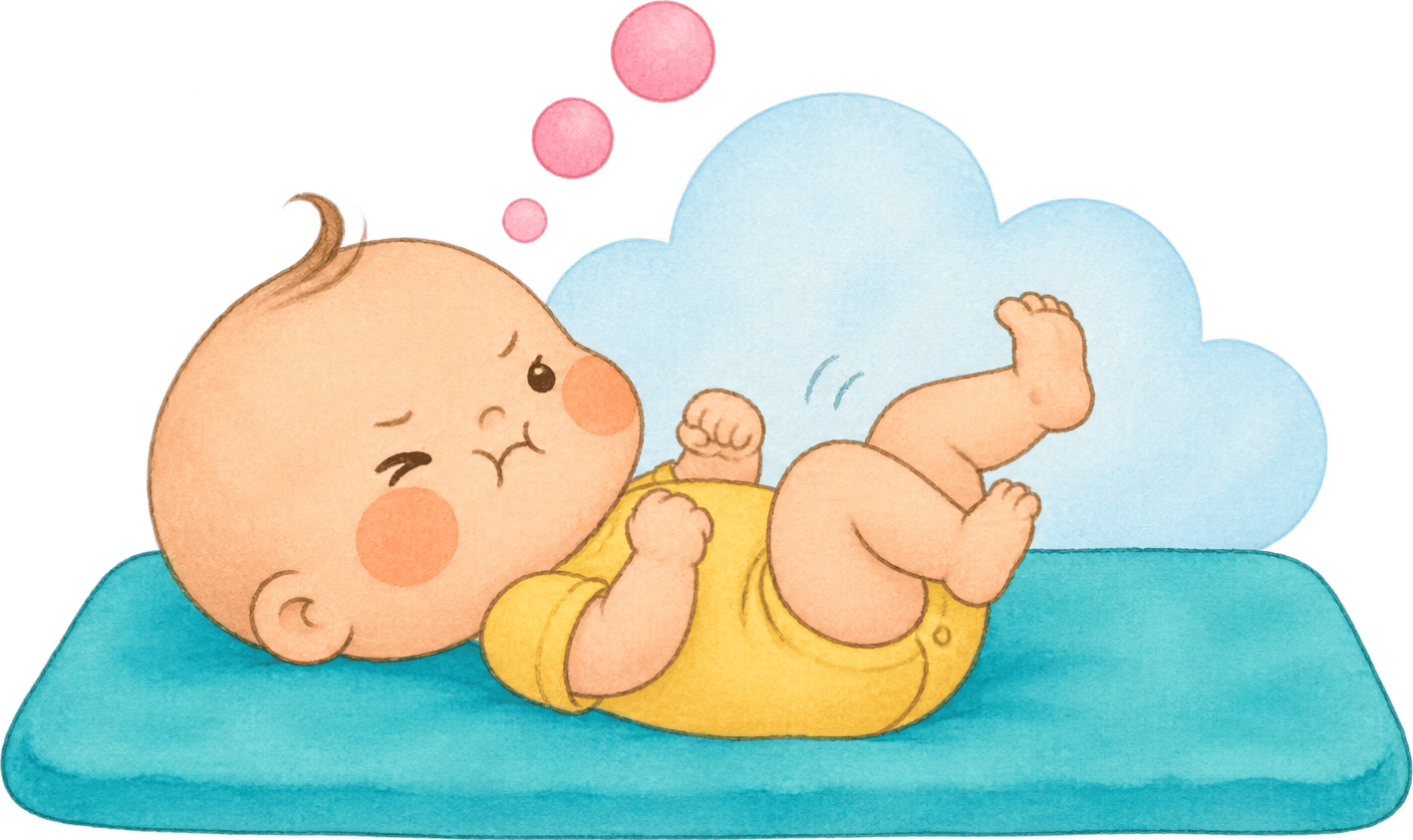

By 3 PM the day almost felt manageable. Two decent naps, a feed that went fine, maybe even a warm coffee. Then the light fades and the baby you had this morning is gone. She's red in the face, won't settle in anyone's arms, and the feed that worked at noon buys you five minutes of quiet.
Parents call this the witching hour: a regular stretch of fussing and crying late in the day that most young babies go through. The NHS says crying tends to build from around 2 weeks and ease off around 3 months, and that afternoon and evening are the most common times for spells that are hard to comfort.1 The AAP pins the fussy window at roughly 6 PM to midnight, right when you're running on empty too.2
When does the witching hour start and stop?
The AAP says regular fussing peaks at about 3 hours a day by 6 weeks, then drops to 1 or 2 hours a day by 3 to 4 months.2
A 2017 meta-analysis of 28 diary studies (8,690 babies) smooths that curve out: about 2 hours a day through the first 6 weeks, about 1 hour by 10 to 12 weeks, and no universal spike at exactly 6 weeks. Picture a plateau, then a drop.3
| Baby's age | Average fussing and crying per day | Babies meeting the older colic definition |
|---|---|---|
| 1 to 6 weeks | About 2 hours (117 to 133 minutes) | 17% to 25% |
| 8 to 9 weeks | Drops off after this age | 11% |
| 10 to 12 weeks | About 1 hour (68 minutes) | 0.6% |
Wolke and colleagues, 2017.3 Colic here means the "rule of threes" explained below.
Born early? Count these weeks from your baby's due date, which is called corrected age. In a study of 35 babies born between 28 and 34 weeks of pregnancy, crying peaked, and bunched into the evening, at about 6 weeks corrected age.4 A baby born 6 weeks early might hit the hardest evenings closer to 3 months after birth.
Why do newborns cry more in the evening?
Nobody knows for sure. Writing about colic, the AAP says there's no definite explanation; most often it reflects a baby who is unusually sensitive to stimulation and can't yet calm themselves, because their nervous system is still immature.2
The timing looks built into development. Preterm babies still peak about 6 weeks after their due date, despite weeks of extra life outside the womb, which the researchers read as a sturdy part of normal maturation that may be universal.4
It shows up far from Western nurseries too. Among !Kung San babies in Botswana, a hunter-gatherer community whose care tends toward quieter babies, crying still rose in the first 3 months with the same early peak. Care changed how long the crying lasted, not the pattern.5
Is the witching hour the same as colic?
In most cases, colic seems to be the far end of the same curve. A review of the Rome IV criteria (the definitions pediatric gut specialists use) says most excessive crying has no clear cause and probably sits at the upper end of normal. An underlying illness turns up in fewer than 5% of babies brought in for crying that can't be soothed.6
For decades, colic meant the "rule of threes": crying more than 3 hours a day, on at least 3 days a week. Rome IV dropped that cutoff in 2016 as arbitrary (2 hours and 50 minutes isn't really different from 3 hours) and now looks at long, hard-to-soothe crying with no obvious cause.6
The AAP puts colic at about one in five babies, usually starting between the second and fourth weeks and generally gone by 3 to 4 months (sometimes 6). Its first step for a colicky baby is a pediatrician visit to rule out a medical cause.2
Is evening fussiness linked to cluster feeding?
Often, yes. Many parents find the fussy stretch and a run of back-to-back feeds land on the same evening. The NHS says cluster feeding usually happens in the first 3 to 4 months, by day, by night or both. Formula-fed babies do it too, though the NHS cautions against overfeeding.7
Hunger tops the NHS's list of reasons babies cry, and letting a breastfed baby suckle is the first calming idea on its list.1 Our cluster feeding post covers that side of the evening, and our guide to newborn hunger cues shows how to tell when your baby is hungry.
Crying mainly during feeds is worth raising with your pediatrician. The NHS notes it can be a sign of reflux,1 and our reflux and spit-up guide explains what's normal. If your baby strains, squirms and grunts after feeds, see our post on gas and grunting.
What helps a fussy baby in the evening?
What saved Tuesday may flop on Wednesday, but these are the ideas the NHS and AAP suggest:1,2
- Holding them close, in your arms or a sling or carrier, and moving: swaying, walking, talking or singing.
- Rocking them, or a stroller walk or a short drive.
- Something steady in the background: a fan, the dryer in the next room, gentle white noise. (Never on top of the washer or dryer, the AAP warns.)
- Offering the breast, or a pacifier, which the AAP says brings instant relief for some babies.
- A warm bath. The NHS says it calms some babies and makes others cry harder.
- Turning things down. Too much rocking and singing can keep a baby awake, the NHS says.
Some evenings, nothing works. The NHS says that with colic there may be little you can do except comfort your baby and wait it out.1 The AAP adds that healthy, well-loved babies may cry 1 to 2 hours every day, and that it doesn't make you a bad parent.8
When your baby finally drifts off, the AAP's safe-sleep basics apply: on their back, on a firm, flat surface with nothing soft in it, and out of a car seat or sling as soon as you can. Nodding off on the sofa or in an armchair with the baby on you? Put them in their own crib or bassinet first.9
What if the crying is too much for you?
Never shake a baby. The AAP is blunt about why: shaking can cause blindness, brain damage or death.2
If you feel yourself losing control, the AAP's advice is to lay your baby on their back in a safe place, such as a crib with no blankets or stuffed animals, and leave the room for about 10 to 15 minutes. Check on them, and pick them up once you've calmed down.2,8 The AAP says plainly that this is OK. Plenty of parents need to hear that at 10 PM.
Tag someone in when you can. The AAP suggests handing the baby to a family member or friend and getting out of the house, even for an hour or two, and telling your own doctor if you feel depressed or are struggling.2 Our postpartum recovery notes guide has ideas for keeping track of how you're doing.
When should you call the pediatrician about crying?
The NHS lists these signs that crying may mean a baby is unwell:1
- The cry doesn't sound like their normal cry
- They cry constantly and you can't console or distract them
- They show signs of illness, such as a high temperature (our fever guide explains how age changes the advice)
- They aren't interested in feeding
For a seizure, trouble breathing, or a baby who is floppy, unresponsive or harder to wake than usual, the NHS says to call emergency services.1
It also suggests keeping a record of when and how often your baby cries, since a pattern (after every feed, or every evening) helps a doctor look for a cause.1 If you already log feeds and sleep in nappi, jotting the crying into the note on the nearest feed or nap keeps that pattern on the timeline the whole family sees.
Frequently asked questions
How long is too long for an evening fussy spell?
The AAP's rule of thumb: if your baby calms within a few hours and is fairly peaceful the rest of the day, there's no reason for alarm. Crying that builds and lasts through the day or night may be colic, which is worth a conversation with your pediatrician.2
Is my breast milk or formula causing the crying?
Rarely. The AAP says fewer than 5% of colicky crying comes from a food sensitivity. In some breastfed babies colic can be a reaction to something in the nursing parent's diet, and the AAP suggests talking with your pediatrician before cutting foods or switching formula.2
For the next week, jot down when the fussing starts and what helped. It won't fix tonight, but it lets you watch the curve bend. For the longer view, the bedtime guide and sleep needs by age show how evenings and sleep change in the months ahead.
References
1. NHS. "Soothing a crying baby." nhs.uk
2. American Academy of Pediatrics. "Colic Relief Tips for Parents." HealthyChildren.org. healthychildren.org
3. Wolke D, Bilgin A, Samara M. "Systematic Review and Meta-Analysis: Fussing and Crying Durations and Prevalence of Colic in Infants." J Pediatr. 2017;185:55-61.e4. PubMed
4. Barr RG, Chen S, Hopkins B, Westra T. "Crying patterns in preterm infants." Dev Med Child Neurol. 1996;38(4):345-355. PubMed
5. Barr RG, Konner M, Bakeman R, Adamson L. "Crying in !Kung San infants: a test of the cultural specificity hypothesis." Dev Med Child Neurol. 1991;33(7):601-610. PubMed
6. Zeevenhooven J, Koppen IJ, Benninga MA. "The New Rome IV Criteria for Functional Gastrointestinal Disorders in Infants and Toddlers." Pediatr Gastroenterol Hepatol Nutr. 2017;20(1):1-13. PMC5385301
7. NHS. "Cluster feeding." Best Start in Life. nhs.uk
8. Haney SB, American Academy of Pediatrics. "Shaken Baby Syndrome: Protect Your Infant from Abusive Head Trauma." HealthyChildren.org. healthychildren.org
9. American Academy of Pediatrics. "Safe Sleep: 9 Ways to Reduce a Baby's Risk of SIDS & Suffocation." HealthyChildren.org