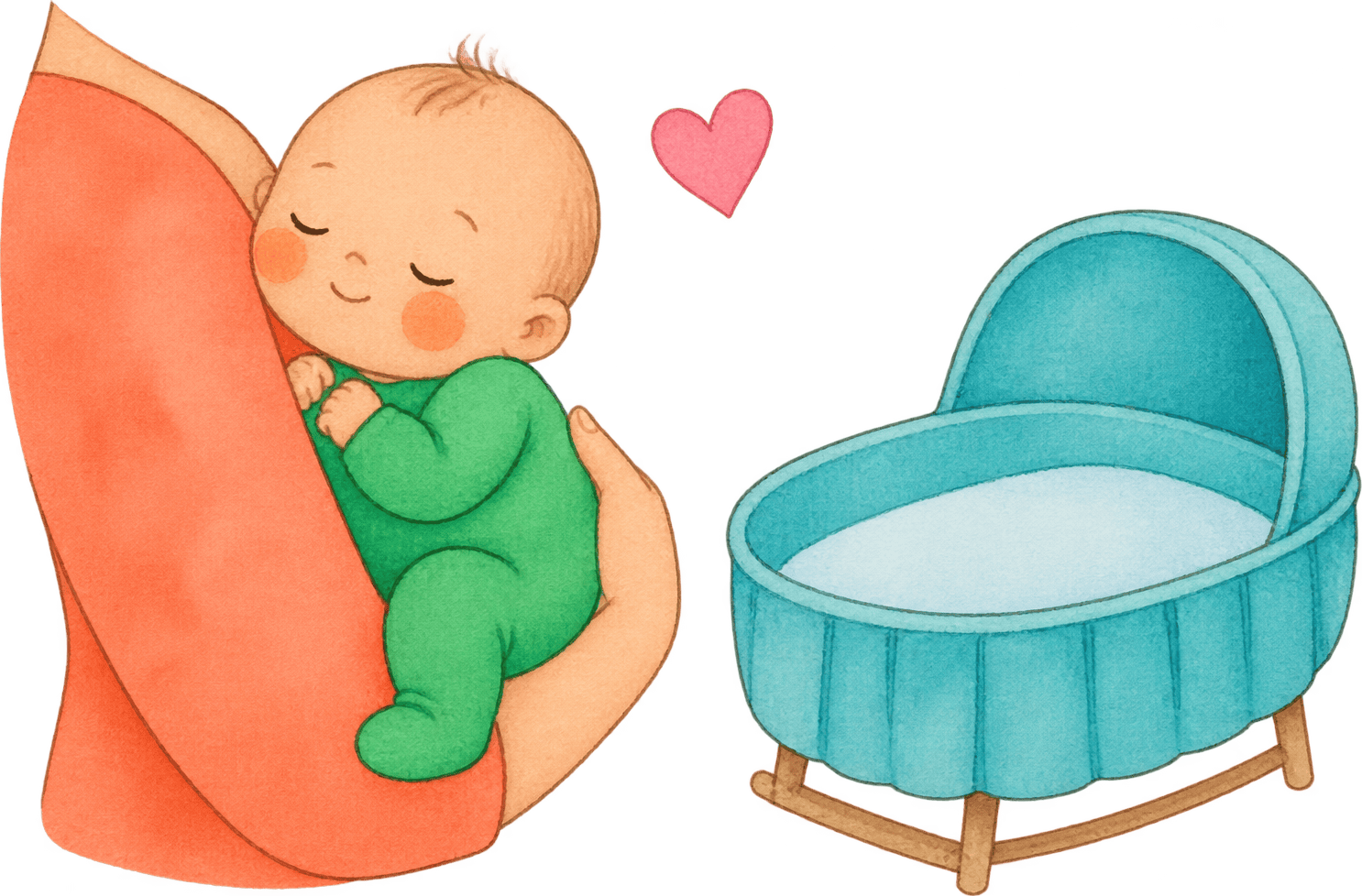
Forty minutes in, your baby is finally asleep on your chest. Your arm went numb a while ago, your water is just out of reach, and the bassinet is three steps away. You stand up as slowly as a person can, lean over, start to let go, and both eyes snap open.
Contact naps, where a baby sleeps on or in the arms of an awake adult, are normal in the first few months, and they aren't a bad habit you're building. Newborns fall asleep into an active, twitchy stage of sleep and settle best with movement. They also have a startle reflex that fires when the head tips back, and a transfer can easily set it off. One rule doesn't bend, though: whoever is holding a sleeping baby has to stay awake.
Why does my newborn only sleep on me?
Newborns usually fall asleep straight into active sleep, the REM-like stage, and that stays the typical pattern until about 2 to 3 months.1
Active sleep makes up about half of a full-term newborn's sleep, and you can spot it: fluttering eyelids, uneven breathing, twitches, sucking and little mouth movements.1 In quiet sleep, the body goes still and breathing turns steady and regular.1
Movement matters too. In a small 2022 study led by Japan's RIKEN Center for Brain Science, crying babies calmed when their mothers carried them while walking or when a cot rocked them, but not when a mother held them sitting still.2 Five minutes of carrying helped crying babies fall asleep, even during the day.2
You breathe, sway and shift your weight the whole time you hold a baby. A bassinet just sits there.
Then there's the startle. When a newborn's head shifts suddenly or falls backward, or a loud noise surprises them, the Moro reflex kicks in: arms and legs fling out, then pull back in, sometimes with a loud cry.3 Lowering a baby into a bassinet can tip the head back in exactly that way.
The Moro reflex usually peaks in the first month and starts to fade after about 2 months.3
If your baby was born early, count these ages from the due date instead of the birth date. That's called corrected age, and the AAP suggests using it for developmental expectations during the first 2 years.4
Are contact naps a bad habit?
No. The NHS says that particularly in the early weeks, you may find your baby only falls asleep in your arms or your partner's.5 That's a typical newborn. You haven't done anything wrong.
Spoiling isn't a concern in the first months, according to KidsHealth, and newborns who are held or carried during the day tend to have less colic and fussiness.6
A contact nap still counts as a nap, and you get to sit down. If it works for your family, keep going. If you need your hands back for a shower or an older kid, read on.
How do I keep a contact nap safe?
Holding a sleeping baby is only safe while you're awake. The AAP says to put your baby in their own sleep space before you go to sleep, and if you nod off while feeding or comforting them, to move them onto their back in their crib or bassinet as soon as you wake.78
Couches and armchairs are especially dangerous places to doze off with a baby. The AAP says the risk of sleep-related infant death is up to 67 times higher when a baby sleeps with someone on a couch, soft armchair or cushion.7
The AAP's tips for staying awake through exhausted feeds carry over to a long contact nap. Check how tired you are before you settle in, then:8
- Pick a spot that isn't a couch or armchair.
- Ask someone to stay with you.
- Set an alarm on your phone or watch to go off every few minutes.
- Put on a podcast, book or show that holds your attention without making you sleepier.
If your baby falls asleep in a car seat, stroller, swing, carrier or sling, the AAP says to move them to a firm sleep surface on their back as soon as possible.7
What should the bassinet look like?
The AAP's safe-sleep basics apply to every nap, not just nights:79
- Your baby goes down on their back, every time.
- The surface is firm and flat. Anything inclined more than 10 degrees isn't safe for sleep, so inclined sleepers are out.
- A fitted sheet and nothing else: no pillows, blankets or bumpers, and no positioners, nursing pillows or loungers.6
- No overheating. One layer more than you're wearing is enough.
How do I move a sleeping baby to the bassinet without waking them?
Give it a few minutes. When the RIKEN researchers filmed mothers laying sleeping babies down, about a third of the put-downs woke the baby within 20 seconds.2
The moment that alerted babies most consistently was when the parent's body started to pull away from theirs.2
Babies who had been asleep longer before the put-down were more likely to stay asleep. The researchers suggest sitting with your sleeping baby for 5 to 8 minutes before laying them down, an idea they say still needs larger studies.2 (You stay awake for those minutes, of course.)
Your baby's body gives clues as well. Twitches, fluttering eyelids and uneven breathing mean active sleep; a still body and steady breathing mean quiet sleep.1 In newborns, a stretch of active sleep lasts about 25 minutes on average, anywhere from 10 to 45.1 If the twitching hasn't stopped, give it a bit longer.
Other things parents try on the way down:
- Support the head the whole way so it doesn't drop back, since a sudden head drop is one of the triggers for the startle reflex.3
- Keep the baby close against your chest as you lower them, and slide your arms out last.
- If they wake up anyway, pick them up, settle them, and try again at the next nap.
Some parents swaddle to soften the startle. The AAP says that's fine if your baby is always on their back, the wrap leaves room to breathe and move the hips, nothing in it is weighted, and you stop once your baby looks like they're trying to roll. Swaddling doesn't lower SIDS risk, the AAP adds.7
How can I get some naps out of my arms?
It doesn't have to be all or nothing. Plenty of families practice one nap a day in the bassinet and keep the others in arms. If that nap is short, it hasn't failed: our short naps guide explains why one sleep cycle is a complete nap before 4 months.
Our wake windows chart shows typical awake time by age, so you can try the bassinet when your baby is actually sleepy.
Taking turns is the other big one. The AAP encourages exhausted parents to ask a trusted friend or family member to step in so they can rest.8 One adult holds the nap while the other sleeps, eats or showers, then you swap.
A shared log makes those handoffs easier. In nappi, whoever takes over can see when the baby fell asleep.
If contact naps tend to follow long evening feeds, see our cluster feeding guide. If your baby sleeps all day and is wide awake at night, our post on day and night confusion explains why. Our 1-month sleep schedule and sleep needs by age show how a whole newborn day fits together.
Pick one nap tomorrow for the bassinet and wait out the twitches before you move. The rest can be contact naps, with an adult who's wide awake.
Frequently Asked Questions
Can I nap while my baby naps on me?
Not with the baby on you. If you're getting sleepy, put your baby on their back in their own crib or bassinet first. The AAP does suggest napping or resting when your baby naps, and its safe-sleep advice puts the baby in their own sleep space for every nap.78
Will my baby ever nap in the bassinet?
Two of the things working against you fade with time. Falling asleep into active sleep is typical until about 2 to 3 months, and the startle reflex starts to fade after about 2 months.13 Many parents find put-downs get easier after that, though plenty of older babies still love a nap in someone's arms. For a baby born early, count those ages from the due date (corrected age).4
References
1. Grigg-Damberger MM. "The Visual Scoring of Sleep in Infants 0 to 2 Months of Age." Journal of Clinical Sleep Medicine. 2016;12(3):429-445. PMC4773630
2. Ohmura N, Okuma L, Truzzi A, et al. "A method to soothe and promote sleep in crying infants utilizing the transport response." Current Biology. 2022;32(20):4521-4529.e4. PubMed
3. American Academy of Pediatrics. "Newborn Reflexes." HealthyChildren.org. healthychildren.org
4. American Academy of Pediatrics. "Corrected Age for Preemies." HealthyChildren.org. healthychildren.org
5. NHS. "Helping your baby to sleep." nhs.uk
6. Nemours KidsHealth. "Sleep and Your Newborn." kidshealth.org
7. Moon RY. "How to Keep Your Sleeping Baby Safe: AAP Policy Explained." HealthyChildren.org. American Academy of Pediatrics. healthychildren.org
8. Moon RY. "Safe Sleep Tips for Sleep-Deprived New Parents." HealthyChildren.org. American Academy of Pediatrics. healthychildren.org
9. Moon RY, Carlin RF, Hand I; Task Force on Sudden Infant Death Syndrome. "Sleep-Related Infant Deaths: Updated 2022 Recommendations for Reducing Infant Deaths in the Sleep Environment." Pediatrics. 2022;150(1):e2022057990. PubMed